
Calculate Roller Chain Length, Centre Distance and Sprocket Sizes
Chain length in links, centre distance, pitch diameters, chain speed, chain pull and a wear check, for ANSI and ISO roller chain
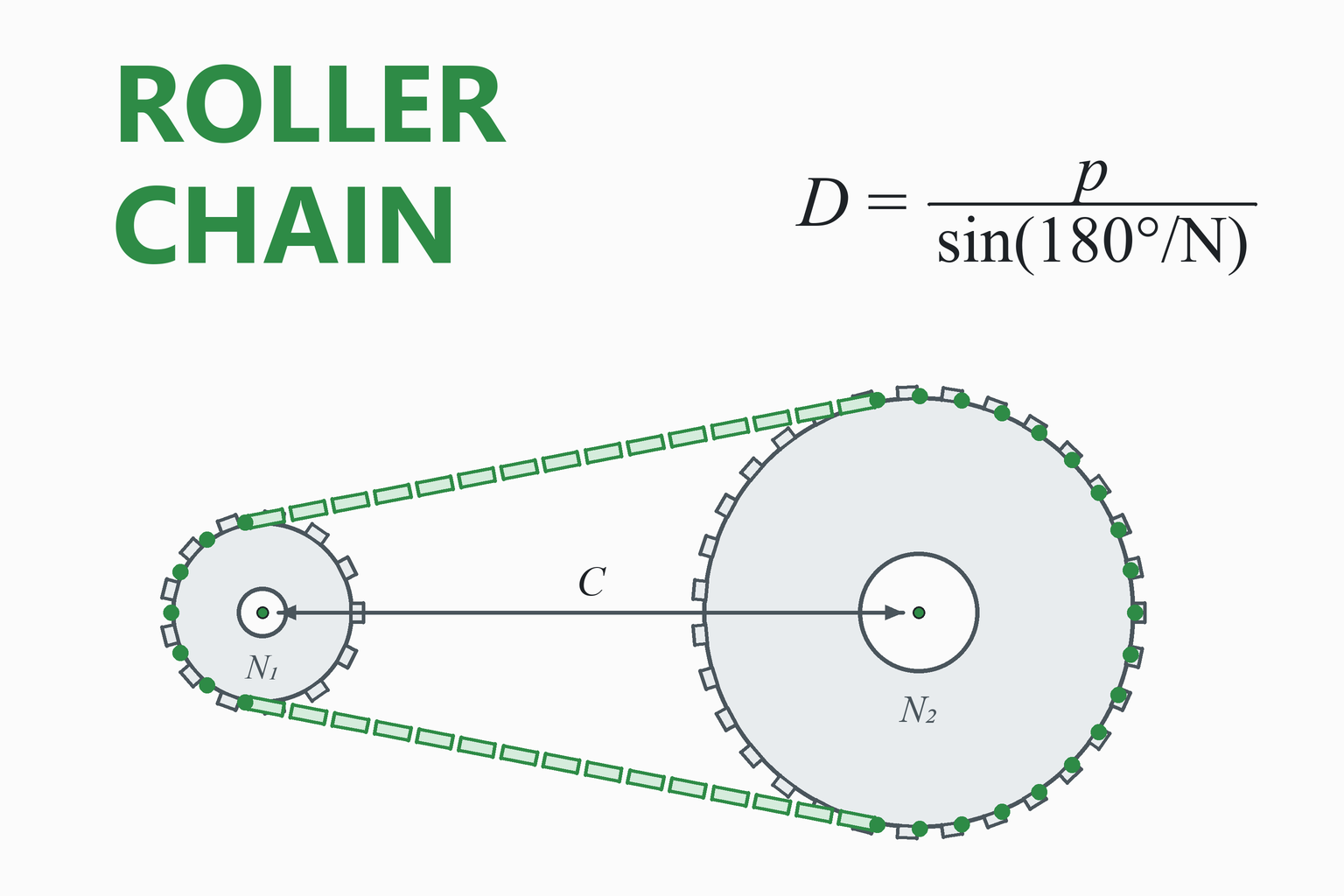
A roller chain drive joins two sprockets with a loop of chain. To build one you need the length of the chain, always a whole and, in practice, even number of links, and the centre distance that this length gives. You also want to know how fast the chain runs, how hard it is pulled and whether the drive follows the usual design rules for tooth counts, wrap angle and span. This calculator takes the chain size, the two tooth counts and either the centre distance or the number of links, and returns the chain length rounded up to an even number of links, the true centre distance with that chain, the pitch diameters, the wrap angle and the chain speed and pull. A second tool checks chain wear from a length measurement.
Roller Chain Drive Calculator
Two-sprocket drive · single strand · chain length from the usual catalogue formula · always rounded up to an even number of links
Your drive, to scale
—
Educational and preliminary-design tool. The calculator does the geometry and the speed; it does not choose the chain size for a given power. That needs the chain manufacturer’s power ratings and service factors, which depend on the make and on the drive. The guideline warnings summarise common catalogue advice and are not rules.
A chain that breaks or a guard that is missing can cause serious injury. Use the manufacturer’s selection method, guard every chain drive, and have safety-critical designs checked by a qualified engineer.
How to Use the Calculator
- Choose the chain. Pick an ANSI or ISO size from the list, or enter a custom pitch.
- Enter the tooth counts. Driver is the sprocket on the motor or power source. The calculator treats the smaller of the two as the “small sprocket” for the wrap angle, whichever one drives.
- Give the spacing. Either the centre distance you want (in mm, inches or chain pitches), or a chain length in links that you already have.
- Read the chain length. It is the exact length from the formula, rounded up to an even number of links, and the centre distance that the rounded chain gives. Adjust the motor position by the small difference shown.
- Add speed and power for the chain speed, the driven speed and the pull on the chain. Compare the pull with the manufacturer’s data when you select the chain.
Tip: make the centre distance adjustable by a few millimetres or one link’s worth if you can. A tensioner or a sliding motor mount takes up the slack as the chain wears.
Worked Example: A 3:1 Reduction with ANSI 40 Chain
Problem. A 1,450 rpm motor drives a conveyor shaft through an ANSI 40 chain (pitch 12.7 mm). The sprockets have 19 and 57 teeth and the centre distance should be about 450 mm. The motor delivers 2.2 kW. Find the pitch diameters, the chain length in links, the actual centre distance, the wrap angle, the speeds and the chain pull.
- Pitch diameters. D = p / sin(180° / N).
D1 = 12.7 / sin(180°/19) = 77.16 mm D2 = 12.7 / sin(180°/57) = 230.54 mm
- Centre distance in pitches.
C = 450 / 12.7 = 35.43 pitches
- Chain length in pitches.
L = 2C + (N1 + N2)/2 + (N2 − N1)² / (4π²C)L = 70.87 + 38 + 38² / (39.478 × 35.43) = 70.87 + 38 + 1.03 = 109.90 pitches
- Round up to an even number of links: 110 links, a chain 1,397 mm long.
- The true centre distance with 110 links (solving the same formula for C):
C = [ (L − 38) + √((L − 38)² − 2 × 38² / π²) ] / 4 = (72 + 69.94) / 4 = 35.485 pitches = 450.65 mm
- Wrap angle on the small sprocket.
180° − 2 × asin((230.54 − 77.16) / (2 × 450.65)) = 160.4°
- Speeds and pull.
driven speed 1,450 × 19 / 57 = 483.3 rpmchain speed v = N1 p n / 60 = 19 × 0.0127 × 1,450 / 60 = 5.83 m/schain pull F = P / v = 2,200 / 5.83 = 377 N
Result: a chain of 110 links (1,397 mm) gives a centre distance of 450.65 mm, 0.65 mm more than asked, so the motor should be mounted with a little adjustment. The chain wraps 160° of the small sprocket, runs at 5.83 m/s and carries a pull of about 377 N. The 19-tooth small sprocket and the 35-pitch span both fall within the usual guidelines.
Checking wear
Measuring 13 pitches of the same chain gives 168.0 mm. The nominal length is 13 × 12.7 = 165.1 mm, so the chain has stretched by 1.76%. That is above 1.5%, the limit that some makers give for fixed-centre drives, and below the 3% limit after which the chain should be replaced.
How a Roller Chain Drive Is Sized
Pitch diameter
A chain wraps a sprocket as a polygon whose corners are the pins, one per tooth. The circle through those pins is the pitch circle, and its diameter follows from the pitch p and the number of teeth N:
Pitch diameter
A 17-tooth sprocket for ANSI 40 chain (p = 0.5 in) has D = 2.721 in, and a 12-tooth one has D = 1.932 in. It is larger than N p / π because the chain lies along chords, not an arc.
Chain length and centre distance
Chain makers use a standard approximation for the length of chain, measured in pitches, that goes round two sprockets with N1 and N2 teeth whose centres are C pitches apart:
Chain length in pitches (the catalogue formula)
The first line gives the length for a known centre distance. The second solves the same equation for the centre distance when the length is known (the larger root of the quadratic). Both C and L are in pitches, so multiply C by the pitch to get a length.
- Round the length up to an even number of links. A chain with an even number of links closes with an ordinary connecting link. An odd number needs an offset link, which is weaker. Round up, not down, because a chain that is too tight can damage the sprockets and shafts.
- The formula is an approximation. Compared with the exact length of a belt around the two pitch circles, it differs by at most about 0.17 of a pitch for sprockets of 17 or more teeth, ratios up to 4:1 and spans of 30 to 50 pitches, and by about 0.4 of a pitch at the extreme corner of the range (a very short span with a very large ratio). That is far less than the tolerance on the length of a real chain.
- Re-solve after rounding. Rounding changes the span a little. The calculator gives the true centre distance for the rounded chain, so you can position the shafts accordingly.
Wrap angle
The chain wraps the small sprocket through an angle of 180° minus 2 asin((Dlarge − Dsmall) / (2C)). The more teeth that engage, the more the load is shared. Chain makers advise at least 120° of wrap on the small sprocket, and a larger ratio needs a longer span to keep it.
Chain speed and pull
Speed and pull
With n in rpm, p in metres and N the teeth on the sprocket that turns at n, the chain speed v is in m/s. A 17-tooth ANSI 40 sprocket at 100 rpm moves the chain at 70.8 ft/min. The pull F follows from power = force × speed, in consistent units; it does not include the extra load from shocks, the tension from the weight of a long span or the centrifugal tension at high speed.
Chordal action
Because the chain wraps a polygon, its speed is not perfectly constant: it varies by 1 − cos(180°/N) over each tooth. This is 4.05% for 11 teeth, 1.70% for 17 and 0.79% for 25. It is one reason chain makers advise a minimum of 17 teeth on the small sprocket for smooth, long-life drives.
Standard Roller Chain Sizes
| ANSI chain | Pitch, in | Pitch, mm | ISO 606 B series |
|---|---|---|---|
| 25 | 1/4 | 6.35 | — |
| 35 | 3/8 | 9.525 | 06B |
| 40 | 1/2 | 12.7 | 08B |
| 50 | 5/8 | 15.875 | 10B |
| 60 | 3/4 | 19.05 | 12B |
| 80 | 1 | 25.4 | 16B |
| 100 | 1-1/4 | 31.75 | 20B |
| 120 | 1-1/2 | 38.1 | 24B |
| 140 | 1-3/4 | 44.45 | — |
| 160 | 2 | 50.8 | — |
| 180 | 2-1/4 | 57.15 | — |
| 200 | 2-1/2 | 63.5 | — |
| 240 | 3 | 76.2 | — |
ISO and ANSI chains of the same pitch have different roller and plate dimensions, so they are not interchangeable even when the pitch matches. Chain and sprocket must be of the same standard.
Design Guidelines the Calculator Checks
| Guideline | Typical advice |
|---|---|
| Teeth on the small sprocket | At least 17 for long life, about 23 for smooth, quiet running. |
| Teeth on the large sprocket | One design guide advises fewer than about 120. |
| Speed ratio | About 7:1 is a sensible maximum for one stage; above about 8:1 a two-stage drive is usually used. |
| Centre distance | 30 to 50 pitches is the optimum in one chain catalogue, about 20 pitches with a pulsating load. Very long spans need support. |
| Wrap angle on the small sprocket | At least 120°. |
| Chain links | An even number, to avoid the weaker offset link. |
Chain Wear and Elongation
A chain does not stretch as metal; it wears at the pins and bushings, so each pitch becomes a little longer. As the pitch grows, the chain rides higher on the sprocket teeth, until it no longer seats and can jump or ride over the teeth. The standard check is to measure the elongation: the extra length of a number of pitches, as a share of nominal.
| Elongation | What manufacturers advise |
|---|---|
| Up to 1.5% | Acceptable. About 1.5% is the limit one maker gives for drives with fixed centre distances, parallel chains or where smooth running matters. |
| 2% | One maker’s guide says to consider replacing the chain to keep the drive performing at its best. |
| 3% | The typical limit for industrial roller chain, depending on the sprocket design: replace the chain, and check the sprockets for wear. |
- Measure taut. Slack chain gives a false reading. Measure over many pitches: a #60 chain over 13 pitches is 9.75 in nominal, so 3% elongation is about 10.04 in.
- Replace the sprockets with the chain when they are worn. A new chain on worn sprockets wears out quickly.
- Lubrication is a major factor in chain life. Follow the chain maker’s lubrication recommendations for your speed and power.
Common Mistakes
An odd number of links
Odd lengths need an offset link, which is weaker and wears faster. Round up to the next even number and adjust the centre distance.
Too tight a chain
A chain with no slack loads the bearings and shafts and wears fast. Allow a little sag on the slack side, and use an adjustable mount or tensioner.
Small sprockets
Below about 17 teeth the chain flexes sharply at every tooth and the chordal action is large. Use more teeth if you can.
Using N p / π as the diameter
The pitch diameter is p / sin(180°/N), a little larger. The difference matters for small sprockets.
Selecting by pull alone
Chain selection uses power ratings with service factors for shock, speed and lubrication. A pull below the breaking load is not enough.
No guard
An exposed chain drive can catch clothing and hands. Guard it, and lock out the machine before you touch it.
Assumptions and Limitations
- Two sprockets and one strand. Idlers, tensioners, multiple sprockets, multi-strand chains and double-sided drives are not covered.
- No chain selection. The calculator does not rate the chain for the power. Use the chain maker’s power-rating tables and service factors.
- Catalogue length formula. It is an approximation, within a fraction of a pitch of the exact length for normal drives.
- Pull is the tight-side load only. It ignores shock loads, centrifugal tension and the tension of a heavy span.
- Pitch circles only. Sprocket outside diameters and bores are not calculated; they depend on the roller size and the sprocket maker.
- Wear limits vary. The figures of 1.5%, 2% and 3% are common advice. Follow your chain maker’s own limit.
How This Calculator Was Verified
The calculator was compared with an independent Python implementation over 2,871 random drives (sprockets of 9 to 150 teeth, in either order, spaced 8 to 120 pitches apart; the 129 further random cases whose sprockets would overlap were rejected, as the calculator rejects them). The reference finds the centre distance by bisection on the length formula instead of using the closed-form root, finds the wrap angle from the coordinates of the tangent points, and recomputes the chain speed in inches and feet per minute; everything agrees to rounding error. The catalogue length formula was compared with the exact length of a belt around the two pitch circles, and the chain speed with a published value (a 17-tooth #40 sprocket at 100 rpm gives about 71 ft/min); the wear example uses a published case, a #60 chain measured over 13 pitches, where 3% is 10.04 in. The page also checks itself live:
| Check | Expected | Calculator |
|---|---|---|
| Pitch diameters D = p / sin(180°/N) | 2.7211 in (17 teeth, 1/2 in pitch); 1.9319 in (12 teeth); 77.16 mm (19 teeth, 12.7 mm) | … |
| Chain speed, 17-tooth #40 at 100 rpm | 70.83 ft/min (published: about 71) | … |
| Worked example: 19 and 57 teeth, 450 mm, 12.7 mm pitch | 109.90 pitches, rounded to 110 links; 35.485 pitches | … |
| Round trip: length from centre distance and back | 110.000000 links; 100 links with equal 20-tooth sprockets: 40.000 pitches | … |
| Catalogue formula against the exact length | differences well under one pitch | … |
| Wear: #60 chain, 13 pitches measured as 10.04 in | nominal 9.750 in; elongation 2.97% | … |
| Chordal speed variation 1 − cos(180°/N) | 4.05% (11), 1.70% (17), 0.79% (25) | … |
The “Calculator” column is computed live, by the same code that runs the calculator, in your browser. The design guidelines are taken from chain suppliers’ advice and are not checked against a standard.
Frequently Asked Questions
How do I calculate the length of a roller chain?
Express the centre distance C in pitches (centre distance divided by the chain pitch) and use L = 2C + (N1 + N2)/2 + (N2 − N1)² / (4π²C), where N1 and N2 are the numbers of teeth. The result is the chain length in pitches, which is the number of links. Round it up to an even number so that no offset link is needed, then recalculate the centre distance for that length.
Why should a roller chain have an even number of links?
A chain with an even number of links closes with an ordinary connecting link. An odd number needs an offset link, which is weaker than a normal link and wears faster. Round the calculated length up to the next even number, because a chain that is too tight can damage the sprockets and shafts.
How do I calculate the centre distance from the number of links?
Solve the length formula for C. With L the length in links and S = (N1 + N2)/2, the centre distance in pitches is C = [ (L − S) + √((L − S)² − 2 (N2 − N1)² / π²) ] / 4. Multiply by the pitch for a length. For two equal sprockets it reduces to C = (L − N) / 2.
What is the pitch diameter of a sprocket?
It is the diameter of the circle through the chain pins as the chain wraps the sprocket: D = p / sin(180°/N), where p is the chain pitch and N the number of teeth. A 17-tooth sprocket for ANSI 40 chain (1/2 in pitch) has a pitch diameter of 2.721 in. It is a little larger than N p / π because the chain lies along straight chords between the pins.
How many teeth should the small sprocket have?
Chain suppliers’ design notes recommend at least 17 teeth for long life, and about 23 teeth for smooth, quiet running. Fewer teeth make the chain bend sharply at each tooth and increase the speed variation from chordal action, which is 4.05% at 11 teeth, 1.70% at 17 and 0.79% at 25.
What is the best centre distance for a roller chain drive?
One chain catalogue gives 30 to 50 pitches as the optimum, falling to about 20 pitches when the load pulsates; another supplier advises staying under about 60 pitches. The span also has to leave the chain wrapped through at least 120° on the small sprocket. Shorter spans wear the chain faster because each link engages more often, and very long spans need a support.
How do I calculate roller chain speed?
Chain speed is the number of teeth on a sprocket times the pitch times the sprocket’s speed: v = N p n / 60 in m/s, with p in metres and n in rpm. A 17-tooth ANSI 40 sprocket at 100 rpm moves the chain at about 71 feet per minute.
How do I know when a roller chain is worn out?
Measure its elongation: the extra length over a number of pitches, as a percentage of nominal. Measure with the chain taut and over as many pitches as possible. About 3% is the usual limit for industrial roller chain, depending on the sprocket design, one maker advises considering replacement at 2%, and another gives about 1.5% for drives with fixed centres or where smooth running matters. Replace worn sprockets together with the chain.
Does the calculator select the chain size for my power?
No. Choosing the chain needs the manufacturer’s power ratings for the chain, the sprocket tooth count and speed, adjusted by service factors for shock loads and the type of drive. The calculator gives the geometry, the speed and the chain pull, which you can compare with the manufacturer’s data.
What is the difference between ANSI and ISO roller chain?
Both are standard families of roller chain. The ANSI chain number is the pitch in eighths of an inch, so ANSI 40 is 1/2 in (12.7 mm) and ANSI 80 is 1 in (25.4 mm). ISO 606 describes the metric B series, such as 08B (12.7 mm) and 16B (25.4 mm). Chains of the same pitch in the two standards have different roller and plate dimensions, so use sprockets made for the same standard as the chain.
References and Further Reading
- ASME B29.1, Precision Power Transmission Roller Chains, Attachments, and Sprockets. (The ANSI roller chain standard.)
- ISO 606, Short-pitch transmission precision roller and bush chains, attachments and associated chain sprockets.
- Budynas, R. G., & Nisbett, J. K. Shigley’s Mechanical Engineering Design. McGraw-Hill. (Roller chain length, speed and power-rating methods.)
- Chain manufacturers’ catalogues and engineering guides (for example Tsubaki, Renold, Diamond Chain and Rexnord): design recommendations, power-rating tables, lubrication and wear limits.