
Calculate V-Belt Length, Centre Distance and Wrap Angle
Belt pitch length for a given spacing, or the spacing for a belt you have, with wrap angles, belt speed and the tensions in the belt
When you design a V-belt drive you usually know the two pulley sizes and roughly how far apart the shafts are, and you need to buy a belt of a standard length. Because the length comes in steps, the real centre distance then has to be recalculated, and the belt has to wrap enough of the small pulley to grip. This calculator gives the belt pitch length for a centre distance, or the centre distance for a belt length you pick, together with the wrap angle on each pulley, the speed ratio, the belt speed and the driven speed. If you add the power, it also finds the tight and slack side tensions from the wedge action of the groove.
V-Belt Drive Calculator
Two pulleys, open belt · pulley diameters are pitch diameters · belt length is the pitch (effective) length
Your drive, to scale
—
Educational and preliminary-design tool. The calculator does the geometry, the speed and the belt tensions. It does not select the belt section or the number of belts for a given power; that needs the belt manufacturer’s power ratings, service factors and pulley-size limits. The tensions ignore centrifugal tension.
A belt that fails or a guard that is missing can cause serious injury. Use the manufacturer’s selection method, guard every belt drive, and have safety-critical designs checked by a qualified engineer.
How to Use the Calculator
- Enter the pulley pitch diameters. Driver is the pulley on the motor or power source. The calculator works out the smaller of the two for the wrap angle, whichever one drives.
- Choose what you know. If you know the centre distance you want, the result is the belt pitch length. Pick the nearest standard belt, then switch the mode to “Belt pitch length” and enter that length to see the real centre distance.
- Check the wrap angle. The belt should wrap at least about 120° of the small pulley. If it does not, increase the centre distance or use a smaller ratio.
- Add speed and power for the belt speed, the driven speed, the effective tension and the tight and slack side tensions.
- Make the shaft position adjustable. A belt needs tensioning and stretches in service, so allow movement of the motor or an idler.
Tip: a change of belt length is shared between the two straight runs, so each 10 mm of belt moves the shafts apart by only about 5 mm. A standard length that is 10 mm off your target costs about 5 mm of centre distance, which a slotted motor mount takes up easily.
Worked Example: A 2.5:1 Reduction
Problem. A 1,450 rpm motor with a 100 mm pitch-diameter pulley drives a 250 mm pulley through a V-belt drive. The shafts should be about 500 mm apart and the drive carries 4 kW. Find the belt pitch length, the real centre distance for a standard belt, the wrap angles, the belt speed and the tensions, taking μ = 0.3 and a groove angle of 36°.
- Belt pitch length.
L = 2C + π(D + d)/2 + (D − d)²/(4C)L = 1,000 + π × 350 / 2 + 150² / 2,000 = 1,000 + 549.78 + 11.25 = 1,561.0 mm
- Pick a standard belt. Suppose the nearest belt in the catalogue has a pitch length of 1,560 mm. The centre distance for it comes from the same equation:
B = 4L − 2π(D + d) = 4 × 1,560 − 2π × 350 = 4,040.9 mmC = [B + √(B² − 32(D − d)²)] / 16 = (4,040.9 + 3,950.8) / 16 = 499.5 mm
- Wrap angle on the small pulley.
180° − 2 asin((D − d)/(2C)) = 180° − 2 asin(150/1,000) = 162.7° (and 197.3° on the large pulley)
- Speeds.
belt speed v = π d n / 60 = π × 0.1 × 1,450 / 60 = 7.59 m/sdriven speed = 1,450 × 100 / 250 = 580 rpm
- Effective tension (the difference between the two sides).
Fe = P / v = 4,000 / 7.59 = 527 N
- Tight and slack side tensions from the wedge action.
μ′ = μ / sin(β/2) = 0.3 / sin 18° = 0.971; F1/F2 = eμ′ θ = e0.971 × 2.84 = 15.8F2 = Fe / (15.8 − 1) = 35.7 N F1 = F2 + Fe = 562.5 N
Result: the drive needs a belt of about 1,561 mm pitch length. A 1,560 mm belt puts the shafts 499.5 mm apart, within half a millimetre of the target. The belt wraps 162.7° of the small pulley, runs at 7.6 m/s and carries a tight-side tension of about 563 N and a slack side of about 36 N while it transmits 4 kW. How many belts that takes, and of what section, comes from the manufacturer’s power tables.
How a V-Belt Drive Is Laid Out
Belt length
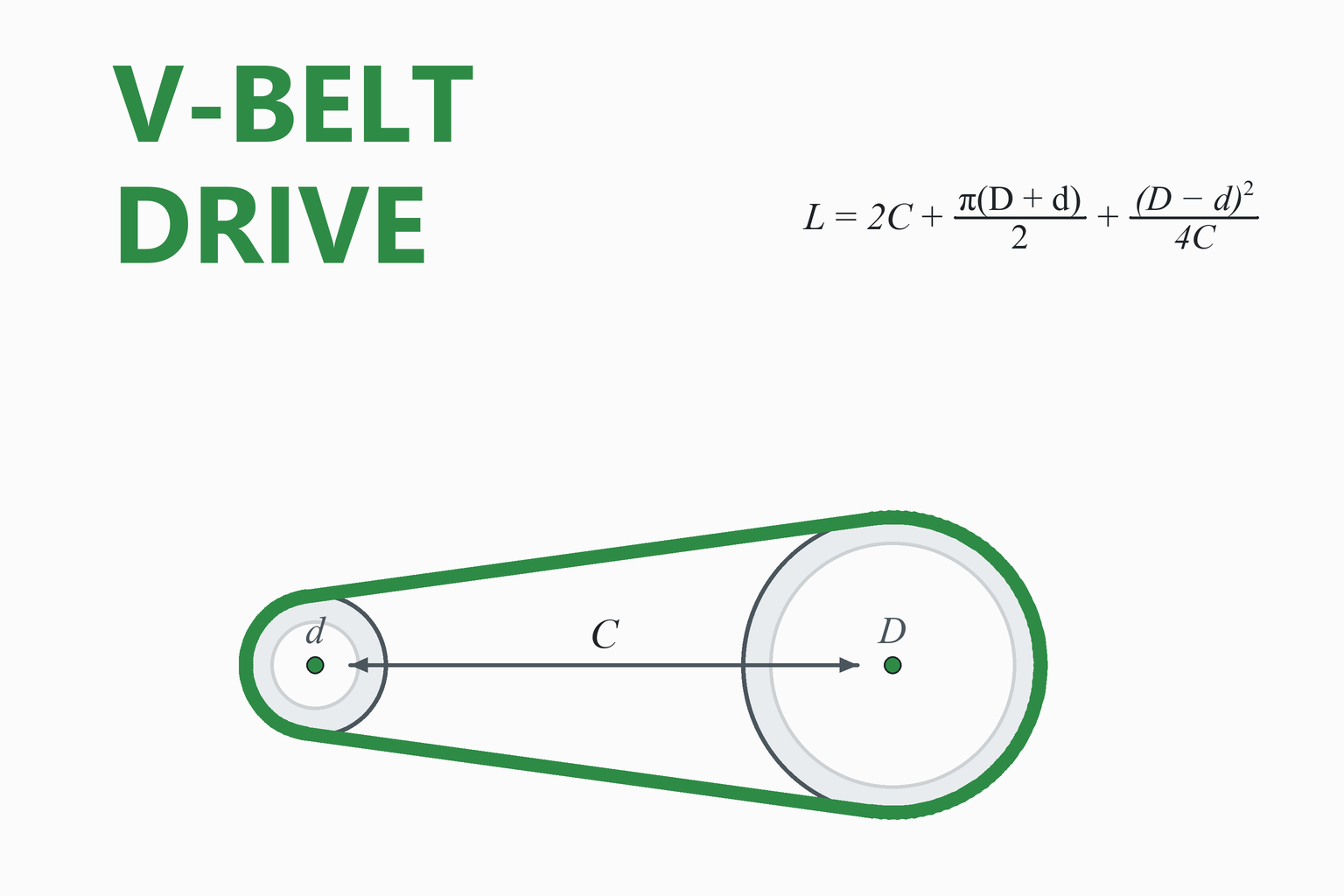
The length of an open belt around two pulleys is, to a good approximation, the two straight runs plus the half circumferences of the pulleys, with a correction for the difference in diameter. With d the small and D the large pulley (pitch diameters) and C the centre distance:
Belt length and centre distance
The first line gives the length for a known spacing. The second is the same equation solved for C (the larger root of a quadratic) when the belt length is known. Some references write 4L − 6.28(D + d) for B, since 2π is 6.283. For C at least as large as D, the formula agrees with the exact length of a belt around two circles to within 0.05%.
- Use the pitch length. A V-belt rides with its pitch line at the pitch diameter of the groove. Catalogues give lengths on that basis (pitch or effective length) and also inside and outside lengths, which are different for every belt section. Take the pitch length from the maker’s table for the belt you intend to buy.
- Use pitch diameters. The pitch diameter of a groove is a little less than the outside diameter of the pulley.
- Round to a standard belt, then re-solve. Standard belts come in fixed lengths. After choosing one, enter it in “Belt pitch length” mode to get the real centre distance and the adjustment you need.
Wrap angle
The belt leaves the small pulley at an angle to the line of centres, so it wraps the small pulley through 180° − 2 asin((D − d)/(2C)) and the large one through 180° plus the same amount. The small pulley has the shorter grip, so it limits the drive. Design references advise a wrap of at least about 120° on the small pulley for V-belts.
Belt speed and effective tension
The belt speed is v = π d n / 60 for a pulley of diameter d turning at n rpm (SI units give m/s). Power is force times speed, so the force that actually transmits power, the effective tension, is Fe = P / v. It equals the difference between the tension on the tight side and on the slack side.
Why a V-belt grips better than a flat belt
A V-belt sits in a groove and is wedged between its sides, so the normal force on the belt is larger than the radial load on the pulley. This multiplies the friction by 1 / sin(β/2), where β is the full angle between the groove sides, and the equation for a belt over a pulley becomes:
Belt tension ratio with wedge action
θ is the wrap angle in radians on the pulley that limits the drive (the smaller one), μ the coefficient of friction between belt and groove and β the groove angle. A smaller groove angle gives a larger wedge effect and a larger possible tension ratio. The two equations give F1 = Fe r / (r − 1) and F2 = Fe / (r − 1), with r = eμ θ / sin(β/2). They describe a belt that is just about to slip; a working drive needs margin, which the manufacturer’s power ratings and service factors provide.
The tensions given here leave out the centrifugal tension, the pull that the belt’s own mass creates as it goes round the pulleys. It grows with the square of the belt speed and reduces the tension available for transmitting power. At low speed it is small.
Practical Guidelines
| Topic | Common advice |
|---|---|
| Wrap angle on the small pulley | At least about 120° for V-belts. A small wrap limits the power the drive can carry. |
| Centre distance | Longer spacing reduces the wrap angle for a given ratio but eases vibration and installation; the calculator warns when the wrap falls below 120°. |
| Pulley size | Each belt section has a minimum recommended pulley diameter. A smaller pulley bends the belt more and shortens its life. Take the limit from the belt maker. |
| Adjustment | Allow the motor or an idler to move so the belt can be fitted without force and re-tensioned as it wears. |
| Multiple belts | Use a matched set. Belts of different lengths share the load unevenly. |
| Guarding | Guard every drive and lock out the machine before working on it. |
Common Mistakes
Using outside diameters
The belt runs on the pitch diameter of the groove, which is smaller than the pulley’s outside diameter. Use the catalogue pitch diameter.
Mixing belt lengths
Inside, outside and pitch lengths are different. The formula gives the pitch length, so compare it with the pitch length in the catalogue.
Ignoring the wrap angle
A big ratio with a short spacing leaves too little belt on the small pulley, and the belt slips even if the belt size is right.
No adjustment
With a fixed centre distance you cannot fit or tension the belt. Provide a slotted mount or a tensioner.
Selecting by tension alone
Belts are selected from power ratings with service factors for the load, speed and hours. The tensions here are for checking, not for choosing.
No guard
An exposed belt drive can draw in clothing and hands. Guard it and lock out before servicing.
Assumptions and Limitations
- Two pulleys, open belt. Crossed belts, idlers, multiple pulleys and serpentine drives are not covered.
- Belt selection is not included. Belt section, number of belts and the power rating of a belt need the manufacturer’s tables.
- Approximate length formula. It is within 0.05% of the exact geometry for normal spacings (C at least D), which is much less than the tolerance on a belt.
- Tensions at the point of slip. The tension ratio is that of a belt that is about to slip, without centrifugal tension. Real working tensions are set by installation tension.
- Friction and groove angle are inputs. They depend on the belt, the pulley material, wear and contamination.
How This Calculator Was Verified
The calculator was compared with an independent Python implementation over 3,000 random drives. The reference finds the centre distance by bisection on the length formula instead of using the closed-form root, finds the wrap angle from the coordinates of the tangent points, and solves the two tension equations by substitution; everything agrees to rounding error. The length formula was compared with the exact length of a belt around the two pitch circles, and the form of the centre-distance relation (B = 4L − 6.28(D + d)) with the form used by a belt-length reference. The page also checks itself live:
| Check | Expected | Calculator |
|---|---|---|
| Belt length, d 100, D 250, C 500 mm | 1,561.03 mm | … |
| Round trip, and equal pulleys | C = 500.000 mm from that length; 2,000 mm belt on two 200 mm pulleys: C = (L − πd)/2 = 685.8 mm | … |
| Centre distance, d 100, D 300, L 1,500 mm | K = 4L − 6.28(D + d) = 3,488 mm; C = 424.0 mm | … |
| Wrap angles, worked example | 162.75° and 197.25°, summing to 360° | … |
| Belt speed, driven speed, effective tension | 7.592 m/s; 580.0 rpm; 526.9 N | … |
| Tensions, μ = 0.3, β = 36° | F1 562.5 N, F2 35.7 N, ratio 15.76 | … |
| Formula against the exact belt length | within about 0.05% for C at least D | … |
The “Calculator” column is computed live, by the same code that runs the calculator, in your browser. The friction coefficient of 0.3 and the 36° groove angle in the example are illustrative values, not data for a particular belt.
Frequently Asked Questions
How do I calculate the length of a V-belt?
For two pulleys with pitch diameters d (small) and D (large) and centre distance C, use L = 2C + π(D + d)/2 + (D − d)² / (4C). It gives the pitch (effective) length of an open belt. For d = 100 mm, D = 250 mm and C = 500 mm it is 1,561 mm. Compare the result with the pitch length in the belt catalogue and choose the nearest standard belt.
How do I find the centre distance from the belt length?
Solve the length equation for C: with B = 4L − 2π(D + d), the centre distance is C = [B + √(B² − 32(D − d)²)] / 16. Some references write B = 4L − 6.28(D + d). The calculator does this when you choose “Belt pitch length” as the known quantity, which is how you find the real centre distance after rounding to a standard belt.
What is the difference between pitch length, inside length and outside length?
A V-belt runs with its pitch line, the line that neither stretches nor shortens as the belt bends, at the pitch diameter of the groove. The pitch (or effective) length is measured on that line, and it is the length the formula gives. The inside and outside lengths are measured on the inner and outer surfaces and differ from the pitch length by an amount that depends on the belt section. Always compare like with like, using the pitch length from the manufacturer’s table.
What wrap angle does a V-belt drive need?
Design references advise a wrap of at least about 120° on the small pulley for V-belts, because it is the small pulley that limits the grip. Less wrap means a smaller tension ratio and less power before the belt slips. You can raise the wrap angle by increasing the centre distance or by reducing the speed ratio.
How do I calculate belt speed?
Belt speed is the pulley circumference times its rpm: v = π d n / 60 in m/s with d in metres. A 100 mm pulley at 1,450 rpm gives 7.59 m/s. The effective tension that carries the power is then Fe = P / v.
How many V-belts do I need?
That depends on the belt section, the pulley sizes, the speed, the wrap angle and a service factor for the load, and it comes from the belt maker’s power-rating tables: divide the design power by the corrected rating of one belt and round up. This calculator does not select belts. It provides the length, the centre distance, the wrap angle, the speed and the tensions to use with those tables.
Why does a V-belt grip better than a flat belt?
A V-belt is wedged into a groove, so the normal force on the belt sides is larger than the radial load on the pulley, and the friction is multiplied by 1 / sin(β/2), where β is the groove angle. The tension ratio is F1/F2 = eμθ/sin(β/2). A narrower groove gives more wedge effect.
How do I find the tight and slack side tensions?
Take the effective tension Fe = P / v, the difference between the two sides, and the tension ratio r = eμθ/sin(β/2) on the small pulley. Then F2 = Fe/(r − 1) and F1 = F2 + Fe. This describes a belt just about to slip and ignores centrifugal tension, so the real working tensions are set by installation tension and the manufacturer’s guidance.
How much does the centre distance change if I use a different belt length?
About half as much. A change in belt length is shared between the two straight runs, so 10 mm more belt moves the shafts about 5 mm further apart. Mount the motor or an idler so that it can move, both for this adjustment and to tension the belt as it wears.
Can I use this calculator for a timing belt or flat belt?
The length and centre distance geometry is the same for any open belt, so you can use it for those drives if you give the correct pitch diameters. The wrap angle and speed are also general. The tension equations are for a V-belt in a groove; a flat belt has no wedge factor, which you get by entering a groove angle of 180°, and a timing belt does not rely on friction at all.
References and Further Reading
- Budynas, R. G., & Nisbett, J. K. Shigley’s Mechanical Engineering Design. McGraw-Hill. (Flat and V-belt drives: length, wrap angle, tension ratio and belt selection.)
- Norton, R. L. Machine Design: An Integrated Approach. Pearson. (Belt drives and their design.)
- ISO 4184, Belt drives: classical and narrow V-belts, lengths. ISO 255, Belt drives: pulleys for V-belts, groove dimensions.
- V-belt manufacturers’ catalogues and engineering guides (for example Gates, Optibelt, Continental and Fenner): belt lengths, pulley minimum diameters, power ratings and service factors.