
Calculate the Material Removal Rate and the Power It Needs
Milling, turning and drilling: cm³/min and in³/min, time to remove a volume, cutting power and torque
The material removal rate (MRR, or metal removal rate) is the volume of metal a cutting tool removes every minute. It is the best single measure of how productive a roughing operation is, and it also decides how much power the machine must deliver, because cutting metal takes a fixed amount of energy for every cubic centimetre removed. This calculator finds the removal rate for milling (depth, width and feed rate), turning (cutting speed, depth and feed) and drilling (diameter, cutting speed and feed), in metric or imperial units. Give it the time to remove a volume and it tells you how long the job takes; add the specific cutting force and the machine efficiency and it works out the net and spindle power and the torque at the cutter, and compares the power with your spindle.
Material Removal Rate Calculator
Removal rate needs only the cut and the feed · power needs the specific cutting force kc of your material
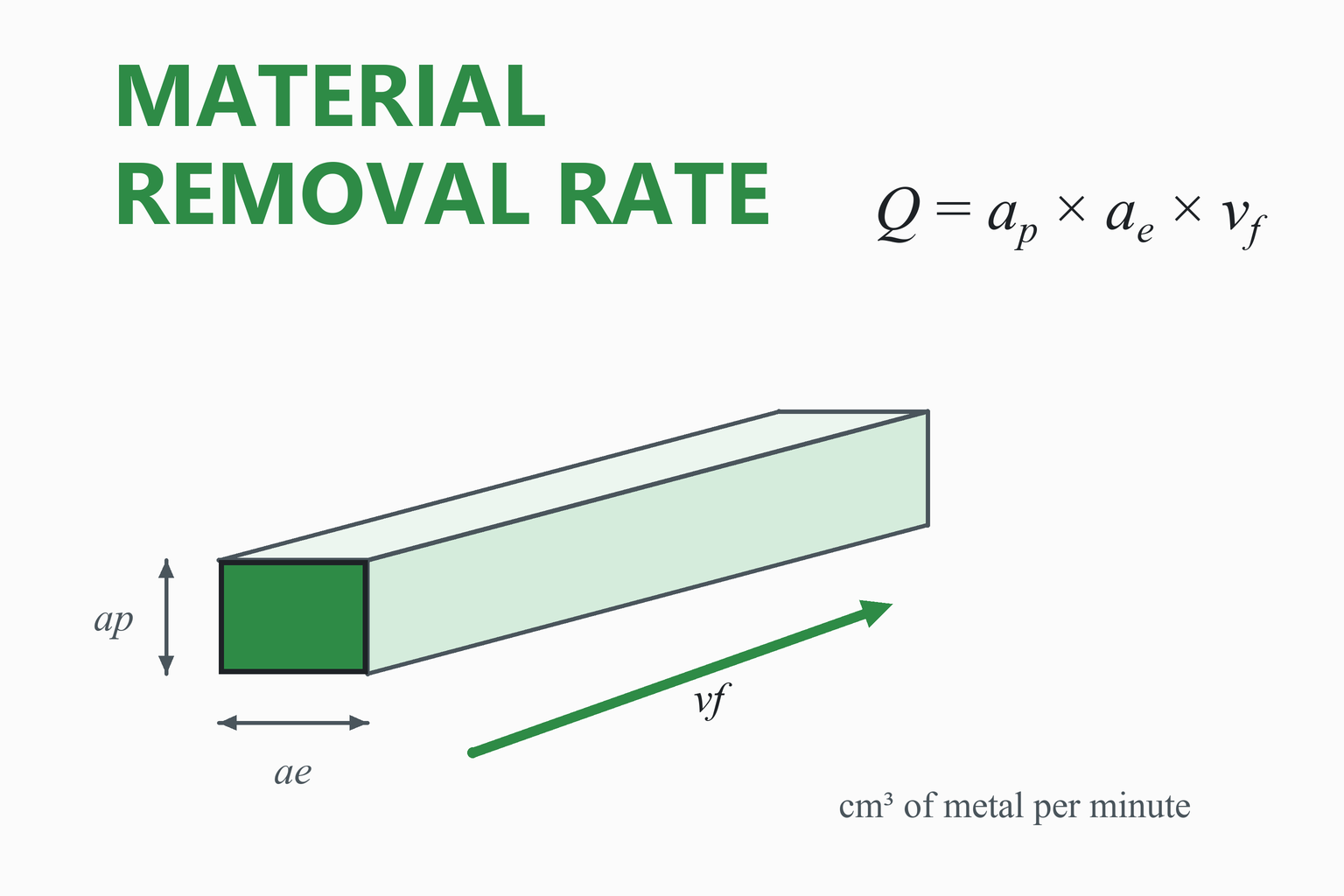
What the removal rate is: a prism of metal per minute
—
Educational and planning tool. The removal rate is simple geometry and is exact for the cut and feed you enter. The power and torque depend on the specific cutting force you supply, which varies with material, chip thickness, tool geometry and wear, so treat them as estimates and compare them with the tool maker’s own data.
The calculator does not check tool life, rigidity, chatter, chip evacuation or the power and torque curve of your spindle. Stay within the tool maker’s limits and the machine’s ratings.
How to Use the Calculator
- Choose the operation and the units. Keep every length in the same system: millimetres with m/min, or inches with feet per minute.
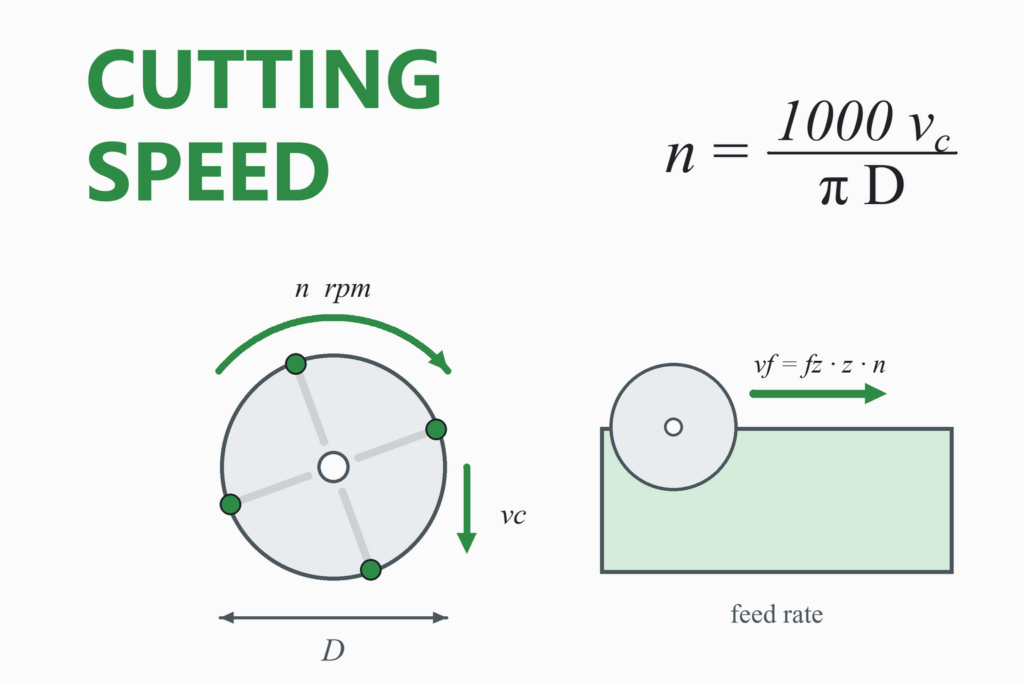
- Enter the cut. In milling this is the axial depth ap (how deep) and the radial width ae (how wide) together with the feed rate, or the feed per tooth, number of teeth and spindle speed if you do not have the feed rate. In turning enter the cutting speed, the depth of cut and the feed per revolution. In drilling enter the drill diameter, the cutting speed and the feed per revolution.
- Read the removal rate in cm³/min and in³/min. Add a volume to see how long the job takes.
- For power and torque, enter the specific cutting force kc from the tool maker’s table for your material and, if you want the motor power, the efficiency of the machine. Add the spindle motor power to see what share of it the cut uses. Torque needs the spindle speed, which turning and drilling work out from the diameter and cutting speed; in milling, enter it yourself.
Tip: if you only want to compare two sets of cutting data, the removal rate is enough: it is the product of the cut cross-section and the speed at which it moves, so doubling the depth, the width or the feed doubles it.
Worked Examples
1. Face milling a block
Problem. A face mill takes a cut 5 mm deep and 180 mm wide at a feed rate of 459 mm/min. The steel has a specific cutting force of about 2,000 N/mm² (an illustrative value) and the machine is 80% efficient. What is the removal rate, and how long does it take to remove 1,000 cm³?
- Removal rate
Q = ap × ae × vf = 5 × 180 × 459 = 413,100 mm³/min = 413.1 cm³/min
- Time for 1,000 cm³
1,000 / 413.1 = 2.42 min
- Power
Pc = Q × kc / (60 × 10⁶) = 413,100 × 2,000 / 60,000,000 = 13.77 kW net; 13.77 / 0.8 = 17.2 kW at the motor
A 22 kW spindle motor would be about 78% loaded.
2. Turning
A 60 mm bar is turned at 200 m/min with a depth of cut of 2 mm and a feed of 0.3 mm per revolution. The removal rate is Q = vc × ap × fn = 200 × 2 × 0.3 = 120 cm³/min, so 800 cm³ of chips takes 6.7 min. With kc = 2,000 N/mm² the net power is 120 × 1,000 × 2,000 / 60,000,000 = 4.0 kW, or 5.0 kW at the motor with an efficiency of 0.8. The spindle speed is 1,061 rpm, so the net torque at the work is 4.0 × 30,000 / (π × 1,061) = 36 N·m.
3. Drilling
A 20 mm drill at 200 m/min with a feed of 0.2 mm per revolution turns at 3,183 rpm and advances at 636.6 mm/min. It removes the area of the hole times the advance: π/4 × 20² × 636.6 = 200,000 mm³/min, which is 200 cm³/min, the same as D × fn × vc / 4 = 20 × 0.2 × 200 / 4. With kc = 2,000 N/mm² the net power is 6.67 kW (8.3 kW at the motor) and the net torque is 20 N·m.
4. Imperial units
An end mill cuts 0.75 in deep and 0.5 in wide at 20 in/min: Q = 0.75 × 0.5 × 20 = 7.5 in³/min (122.9 cm³/min), so 30 in³ takes 4.0 min. With kc = 290,000 psi (2,000 N/mm²), the net power is 7.5 × 290,000 / 396,000 = 5.49 hp, which is 6.9 hp at the motor with an efficiency of 0.8, or 91% of a 7.5 hp spindle.
5. Milling when you know the feed per tooth
A four-flute end mill runs at 6,000 rpm with 0.06 mm per tooth, cutting 10 mm deep and 6 mm wide. The feed rate is 0.06 × 4 × 6,000 = 1,440 mm/min, so Q = 10 × 6 × 1,440 / 1,000 = 86.4 cm³/min and 500 cm³ takes 5.8 min. With kc = 2,000 N/mm² the net power is 2.88 kW and the net torque is 4.6 N·m.
The Formulas
Material removal rate
Whatever the process, the metal removed in a minute is a prism: the cross-section of the chip times the length the tool covers in that minute. The formulas below follow from that.
| Operation | Metric (cm³/min) | Inch (in³/min) |
|---|---|---|
| Milling | Q = ap ae vf / 1000 (mm, mm/min) | Q = ap ae vf (in, in/min) |
| Turning | Q = vc ap fn (m/min, mm, mm/rev) | Q = 12 vc ap fn (ft/min, in, in/rev) |
| Drilling | Q = D fn vc / 4 (mm, mm/rev, m/min) | Q = 3 D fn vc (in, in/rev, ft/min) |
The constants come from the units. In turning, 1 m = 1,000 mm turns vc ap fn from mm³/min into mm³, and dividing by 1,000 gives cm³. In drilling, vf = fn n and n = 1000 vc / (π D) give π/4 D² vf = D fn vc / 4 × 1,000 mm³/min. One cubic inch is 16.387 cm³.
Cutting power and torque
Net power and torque
Pc is the net cutting power in kW, with Q in mm³/min and the specific cutting force kc in N/mm²; Mc is the torque in N·m with n in rpm. In milling this is the form Pc = ae ap vf kc / (60 × 10⁶); in turning, vc ap fn kc / (60 × 10³); in drilling, fn vc D kc / (240 × 10³), all in kW. The power the motor must supply is the net power divided by the machine efficiency η.
The specific cutting force kc is the force needed to cut one square millimetre of chip cross-section, which is also the energy needed per unit volume of metal removed (1 N/mm² is 1 joule per cubic centimetre). That is why power is proportional to the removal rate. It is not a single number for a material: it rises as the chip gets thinner, and depends on the tool geometry, the cutting speed and wear. Tool makers publish a reference value and an exponent for each material group, from which kc at your chip thickness can be worked out. Published values run from several hundred N/mm² for aluminium alloys to roughly 1,400 to 2,500 N/mm² for steels, and higher for hardened steels and many heat-resistant alloys.
Roughing, finishing and removal rate
Roughing aims for a high removal rate: a deep, wide cut at a high feed, limited by the tool, the machine’s power and torque and the rigidity of the setup. Finishing takes a light cut for accuracy and surface quality, and its removal rate is low by design. A high removal rate is not always the goal: a very deep cut can chatter or shorten tool life, and chips must be cleared. In practice it is limited by whichever of power, torque, tool load or stability is reached first, and the power curve of the spindle matters, because many spindles cannot deliver their rated power at low speed.
Units
Tool makers warn that mixing units in these formulas causes serious errors: depth and width in millimetres go with a cutting speed in m/min, and inches go with feet per minute. This calculator converts for you when you switch the unit system, and shows results in both.
Common Mistakes
Mixing units
Depth in inches with a cutting speed in m/min, or millimetres with SFM, gives an answer that is wrong by a large factor. Stay in one system.
Swapping depth and width
ap is the depth along the tool axis, ae the width across the cut. The product is the same, but the cutting conditions are not.
Using feed per tooth as the feed rate
The milling formula needs the feed rate in mm/min (or in/min), which is fz × z × n.
Forgetting the efficiency
The formula gives net power at the cutter. The motor has to supply more, by the losses in the spindle drive.
Treating kc as a constant
The specific cutting force changes with chip thickness, tool and wear. A value for one cut can be well off for another.
Chasing the highest removal rate
The best cut is the one that machines the part in the least time within the limits of tool life, stability and surface finish, not the largest Q.
Assumptions and Limitations
- A constant cross-section. The milling formula assumes the full depth and width are engaged all the time, with no entry or exit, corners or arcs, and no scallops left between passes.
- Round-insert and ball-nose cutters. Their engaged cross-section is not a rectangle. Enter the equivalent depth and width, or use the tool maker’s calculation.
- Solid drilling. The drilling formula is for a drill cutting a full hole in solid metal, not for opening a hole that already exists.
- You supply kc. The calculator has no material database, and the power and torque are as good as the value you give.
- No limits are checked other than the power you enter: not the torque curve, tool life, stability or chip evacuation.
How This Calculator Was Verified
The formulas are those published on the machining formula pages of a cutting-tool maker, in metric and inch versions. The results were compared with an independent Python implementation over 3,000 random cases (milling by feed rate and by feed per tooth, turning and drilling, with power, torque, efficiency, spindle load and time to remove a volume). For imperial inputs the reference uses the inch formulas directly (with their own constants for horsepower), while the page converts to metric first, so the unit conversions are checked as well; the two agree to better than one part in a billion. The page also checks itself live:
| Check | Expected | Calculator |
|---|---|---|
| Face milling: 5 mm × 180 mm at 459 mm/min | Q = 413.1 cm³/min (a published worked example); 25.2 in³/min | … |
| Turning: 200 m/min, 2 mm, 0.3 mm/rev, Ø60, kc 2,000, η 0.8 | Q = 120.0 cm³/min; Pc = 4.00 kW; 1,061 rpm; 36.0 N·m | … |
| Drilling: Ø20, 200 m/min, 0.2 mm/rev, kc 2,000 | Q = 200.0 cm³/min; 636.6 mm/min; 6.67 kW | … |
| Imperial milling: 0.75 in × 0.5 in at 20 in/min, 290,000 psi | 7.50 in³/min = 122.9 cm³/min; 5.49 hp | … |
| Milling from fz 0.06 mm, 4 teeth, 6,000 rpm, 10 × 6 mm | 1,440 mm/min; 86.4 cm³/min; 500 cm³ in 5.79 min | … |
| Same turning cut in both unit systems | 120.000 cm³/min both ways | … |
| Drilling two ways | D fn vc / 4 = π/4 D² vf = 200.0 cm³/min | … |
The “Calculator” column is computed live, by the same code that runs the calculator, in your browser. The specific cutting force of 2,000 N/mm² in the examples is an illustrative value, not data for a particular steel.
Frequently Asked Questions
What is material removal rate (MRR)?
The material removal rate, also called the metal removal rate, is the volume of material a cutting process removes per unit of time, usually in cm³/min or in³/min. It measures how productive a roughing operation is and, with the specific cutting force, how much power the cut needs.
What is the formula for material removal rate in milling?
Q = ap × ae × vf, where ap is the axial depth of cut, ae the radial width of cut and vf the feed rate. With depth and width in mm and the feed rate in mm/min the result is in mm³/min; divide by 1,000 for cm³/min. For example, 5 mm × 180 mm × 459 mm/min = 413,100 mm³/min = 413.1 cm³/min.
What is the formula for material removal rate in turning?
Q = vc × ap × fn in cm³/min, with the cutting speed vc in m/min, the depth of cut ap in mm and the feed per revolution fn in mm/rev. In inch units, Q = 12 × vc × ap × fn in in³/min, with vc in ft/min.
What is the formula for material removal rate in drilling?
A drill removes the area of the hole times the distance it advances: Q = π/4 × D² × vf, where vf = fn × n is the penetration rate. With the cutting speed vc this becomes Q = D × fn × vc / 4 in cm³/min (D in mm, fn in mm/rev, vc in m/min).
What are the units of material removal rate and how do I convert them?
Usually cm³/min in metric work and in³/min in inch work; mm³/min and mm³/s also appear. 1 cm³ is 1,000 mm³, and 1 in³ is 16.387 cm³, so 100 cm³/min is 6.10 in³/min. This calculator shows the rate in cm³/min, in³/min and mm³/min.
How can I increase the material removal rate?
Raise any of the three factors in the product: the depth of cut, the width of cut or the feed (and in turning and drilling the cutting speed). Each is limited: by the power and torque of the machine, by the load the tool can take at its recommended feed, by the rigidity of the setup (chatter) and by the need to clear chips. The right balance is set by the tool maker’s data and the machine, not by the formula.
How is cutting power related to material removal rate?
They are proportional. The net cutting power in kW is Pc = Q × kc / (60 × 10⁶) with Q in mm³/min and kc in N/mm², which says that the power equals the removal rate times the energy needed per unit volume. Double the removal rate with the same material and tool and you double the power.
What is specific cutting force (kc)?
It is the cutting force per unit of chip cross-section, in N/mm², a measure of how hard a material is to cut. It depends on the material, rises as the chip gets thinner and varies with the tool geometry, speed and wear. Tool makers publish tables with a reference value and an exponent for each material group. This calculator takes the value for your cut as an input.
What is the difference between net power and spindle power?
Net power is the power that actually goes into cutting at the tool. The spindle motor must supply more, because some power is lost in the belts, gears and bearings of the drive: the motor power is the net power divided by the machine efficiency. An efficiency of 0.8, for example, means a cut that needs 10 kW at the tool takes 12.5 kW at the motor.
How do I calculate the machining time from the removal rate?
Divide the volume of metal to be removed by the removal rate: T = V / Q. Removing 1,000 cm³ at 413 cm³/min takes 2.4 minutes. It gives the cutting time only, not tool changes, rapid moves, setup or the extra passes a finishing cut needs.
References and Further Reading
- Sandvik Coromant. Machining formulas and definitions (milling, general turning and drilling). (Metal removal rate, net power, torque and machining time, in metric and imperial units.)
- ISCAR. Machining calculations (training material). (Metal removal rate for turning, milling and drilling, with a worked face-milling example.)
- Oberg, E., Jones, F. D., Horton, H. L., & Ryffel, H. H. Machinery’s Handbook. Industrial Press. (Cutting power and the specific cutting force or unit power of common materials.)
- Kalpakjian, S., & Schmid, S. R. Manufacturing Engineering and Technology. Pearson. (Material removal rate and cutting power in machining.)