
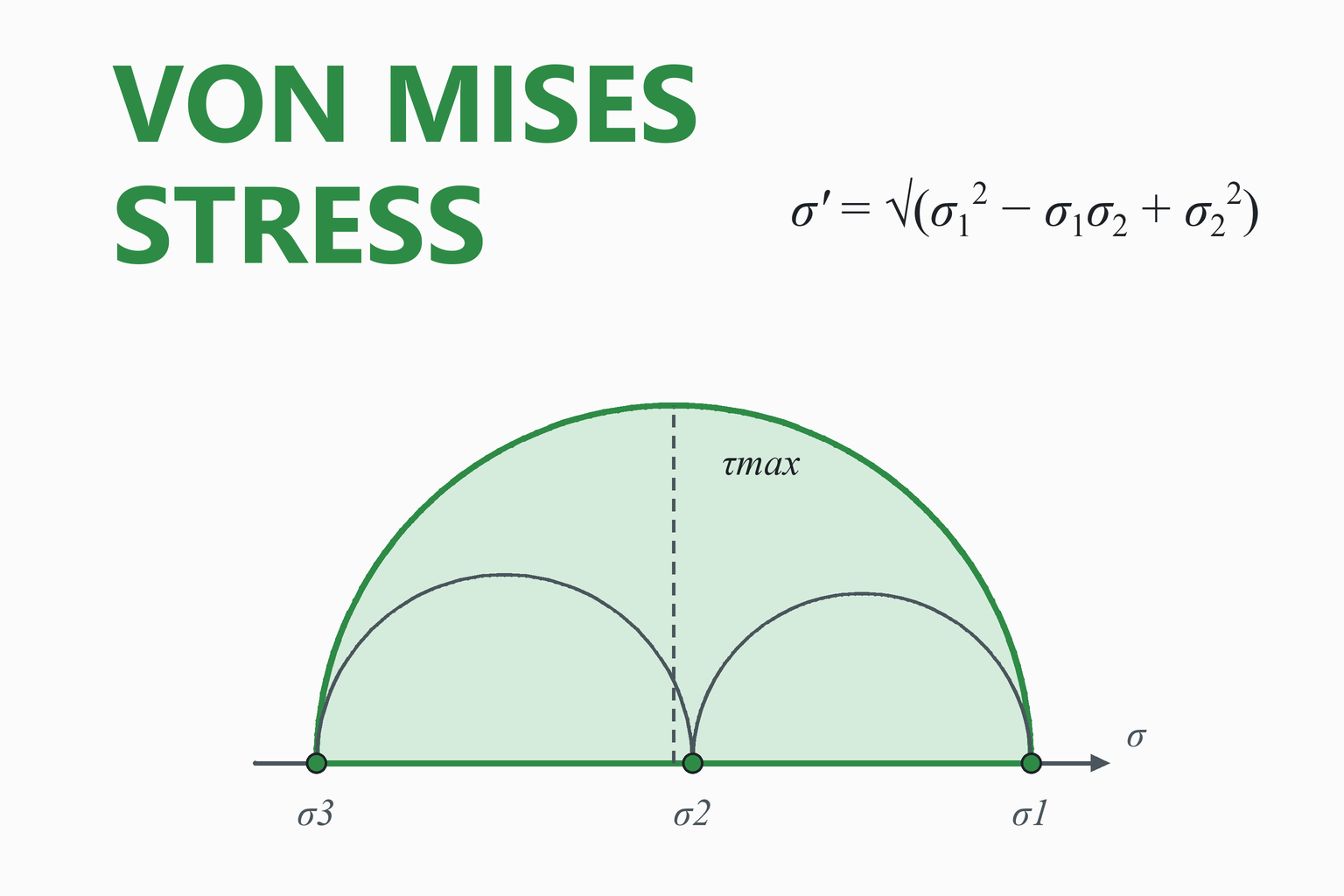
Calculate the Von Mises Stress of Any Stress State
Plane stress, a full 3-D stress tensor, principal stresses or a shaft in bending and torsion, with the factor of safety against yield
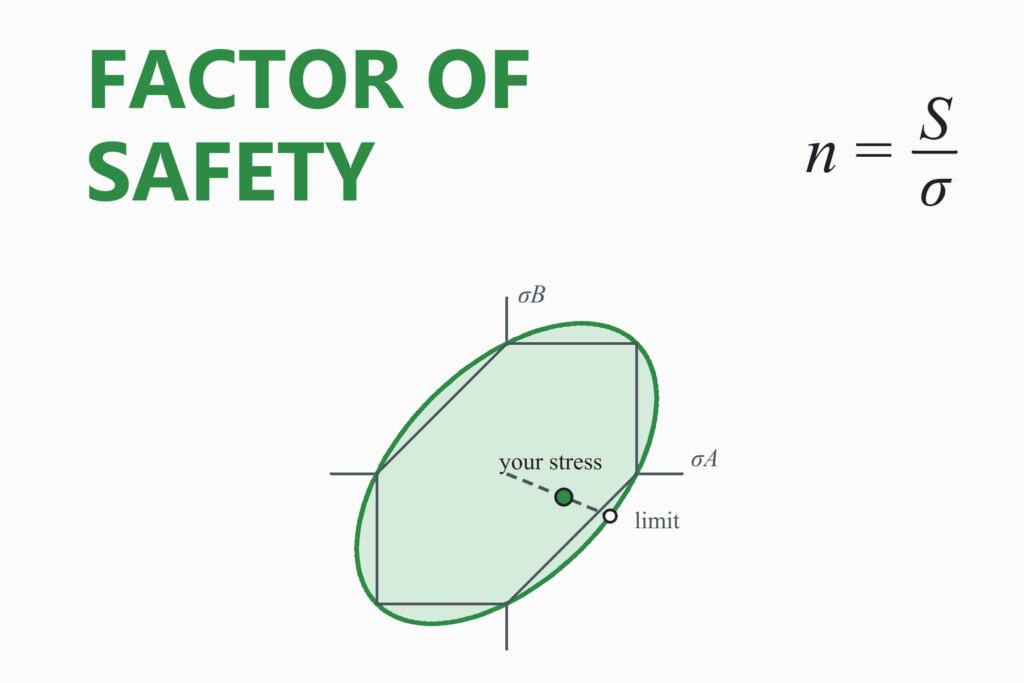
The von Mises stress is a single number that stands in for a whole stress state. A real part is rarely pulled in one direction only: it is stretched, squeezed and sheared at once. The von Mises stress is the uniaxial tension that would store the same distortion energy, so it can be compared directly with the yield strength you read from a tensile test. This calculator gives the von Mises stress from plane stress (σx, σy, τxy), from all six components of a 3-D stress state, from principal stresses, or for the surface of a shaft loaded by a bending moment, a torque and an axial force. It also finds the principal stresses, the maximum shear stress, the Tresca stress and the factor of safety against yielding, and draws Mohr’s three circles.
Von Mises Stress Calculator
Tension positive, compression negative · blank stresses count as zero · for ductile metals under static load
Mohr’s three circles for this stress state
—
Educational and preliminary-design tool. The von Mises stress predicts the start of yielding in a ductile, isotropic metal under a load applied once. It says nothing about fatigue, brittle fracture, buckling, creep or the effect of a stress concentration unless you put that stress in yourself.
The stress state is your input. Check safety-critical parts with the code that applies and have them reviewed by a qualified engineer.
How to Use the Calculator
- Choose how your stress state is described. “Plane stress” for a free surface, a thin plate or a thin shell, where only σx, σy and τxy act. “Full 3-D” for a point inside a solid, or a result copied from a finite element program. “Principal stresses” if you already have σ1, σ2 and σ3. “Shaft surface” to go straight from the loads on a round shaft to the stress.
- Enter the stresses with tension positive and compression negative. A stress you leave blank counts as zero.
- Add the yield strength to get the factor of safety. Pick a typical material or type the minimum yield strength of your grade, and add a required factor if you have a target.
- Read the results. The big number is the von Mises stress. The table gives the principal stresses, the maximum shear stress, the Tresca stress and the factor of safety by both criteria. The chart draws Mohr’s three circles; the larger they are, the more the stress state distorts the material.
Tip: the von Mises stress is the same whichever axes you use to describe the stress state, which makes it a safe number to compare. If you turn the axes, σx, σy and τxy all change but the von Mises stress does not. The page checks that live below.
Worked Examples
1. A thin-walled pressure vessel
Problem. In the wall of a thin cylinder under internal pressure the hoop stress is 120 MPa and the axial stress is half of that, 60 MPa. The steel has a yield strength of 250 MPa. What is the factor of safety against yielding?
- The stress state is biaxial with no shear: σx = 120 MPa, σy = 60 MPa, τxy = 0 (the radial stress is small and is neglected).
- Von Mises stress
σ′ = √(σx² − σxσy + σy²) = √(14,400 − 7,200 + 3,600) = √10,800 = 103.9 MPa
- Factor of safety
n = Sy / σ′ = 250 / 103.9 = 2.41
Result: σ′ = 103.9 MPa, which is 0.866 of the hoop stress, and n = 2.41. Comparing the hoop stress alone with the yield strength would have given 2.08 and been too cautious, because the axial stress partly cancels the effect of the hoop stress on distortion.
2. A full three-dimensional stress state
Problem. At a point in a steel part (Sy = 350 MPa) the stress components are σx = 80, σy = −20, σz = 40, τxy = 30, τyz = −25 and τzx = 15 MPa.
- Von Mises stress from the components
σ′ = √(½[(σx − σy)² + (σy − σz)² + (σz − σx)²] + 3(τxy² + τyz² + τzx²))= √(½[10,000 + 3,600 + 1,600] + 3(900 + 625 + 225)) = √(7,600 + 5,250) = √12,850 = 113.4 MPa
- Principal stresses (the eigenvalues of the stress tensor): σ1 = 89.72, σ2 = 48.72 and σ3 = −38.44 MPa. Their sum, 100, equals σx + σy + σz, as it must.
- The same von Mises stress from the principal stresses
σ′ = √(½[(89.72 − 48.72)² + (48.72 + 38.44)² + (−38.44 − 89.72)²]) = √12,850 = 113.4 MPa
- Factor of safety. n = 350 / 113.4 = 3.09 by von Mises. The Tresca stress is σ1 − σ3 = 128.2 MPa, which gives the more cautious n = 2.73.
The maximum shear stress is (89.72 + 38.44) / 2 = 64.08 MPa and the mean stress is 33.3 MPa.
3. A shaft in bending and torsion
Problem. A solid steel shaft of 40 mm diameter (Sy = 530 MPa) carries a bending moment of 500 N·m and a torque of 400 N·m. Find the factor of safety against yielding.
- Bending stress at the surface
σ = 32 M / (π d³) = 32 × 500 / (π × 0.04³) = 79.58 MPa
- Torsional shear stress
τ = 16 T / (π d³) = 16 × 400 / (π × 0.04³) = 31.83 MPa
- Von Mises stress
σ′ = √(σ² + 3τ²) = √(6,333 + 3,040) = 96.81 MPan = 530 / 96.81 = 5.47
The Tresca (maximum shear) stress, √(σ² + 4τ²) = 101.9 MPa, would give n = 5.20.
4. Pressure from all sides does not yield a metal
Put a steel block under a hydrostatic pressure of 100 MPa, so that σx = σy = σz = −100 MPa and all shears are zero. The three principal stresses are equal, the three Mohr’s circles shrink to a point, and the von Mises stress is exactly zero. The block gets a little smaller but its shape does not change, and the distortion energy is nil. That is why the von Mises criterion, unlike the largest-normal-stress rule, does not predict yielding under huge all-round pressure.
What the Von Mises Stress Is
The von Mises equivalent stress
In terms of the stress components, the same quantity is √(½[(σx − σy)² + (σy − σz)² + (σz − σx)²] + 3(τxy² + τyz² + τzx²)). Yielding is predicted when σ′ reaches the yield strength Sy, so the factor of safety is n = Sy / σ′.
Why it works: distortion energy
The strain energy in a stressed body can be split into two parts: one that changes its volume, and one that changes its shape. Pure all-round pressure only changes the volume. Experiments on ductile metals show that yielding is a shear process that depends on the shape-changing part, and the von Mises criterion states that yielding begins when the distortion energy per unit volume reaches the value it has in a simple tension test at yield. That value is the same as setting σ′ equal to Sy. The criterion is also called the maximum distortion energy theory or the Maxwell–Huber–Hencky–von Mises theory, after the people who developed it. The related octahedral shear stress, τoct = (√2 / 3) σ′, gives an equivalent picture: yielding when the shear stress on the planes equally inclined to the principal axes reaches a critical value.
Useful special cases
| Stress state | Von Mises stress |
|---|---|
| Uniaxial tension or compression σ | σ′ = |σ|, so yielding at σ = Sy (the definition) |
| Pure shear τ | σ′ = √3 τ, so yielding in shear at τ = Sy / √3 = 0.577 Sy |
| Plane stress σx, σy, τxy | σ′ = √(σx² − σxσy + σy² + 3τxy²) |
| Normal stress σ with shear τ (shaft, beam) | σ′ = √(σ² + 3τ²) |
| Solid round shaft, bending M and torque T | σ′ = (32 / πd³) √(M² + ¾T²) |
| Equal biaxial σ | σ′ = σ |
| Hydrostatic (all three principal stresses equal) | σ′ = 0 |
Principal stresses and Mohr’s circles
The principal stresses are the three normal stresses on the planes where the shear stress vanishes. They are the eigenvalues of the 3 × 3 stress tensor, and the calculator finds them numerically. In plane stress one of them is zero, and the other two follow from the familiar Mohr’s circle formula. The three circles drawn in the chart connect the three pairs of principal stresses: the largest runs from σ3 to σ1 and its radius is the maximum shear stress, which is what the Tresca criterion uses.
Von Mises or Tresca?
The Tresca criterion predicts yielding when the maximum shear stress reaches Sy / 2, that is when σ1 − σ3 reaches Sy. It is simple and always on the safe side of von Mises, by at most about 15%; the two agree in uniaxial tension and differ most in pure shear. For ductile steels and aluminium the von Mises criterion fits test data more closely, so it is the usual choice for analysis, and Tresca is used when a conservative or hand-calculable answer is wanted.
Von Mises stress in finite element analysis
Finite element programs usually plot the von Mises stress as a colour map because it is a single positive number at every point that can be compared with the yield strength. Two cautions: the stress next to a sharp re-entrant corner, a point load or a rigid connection depends on the mesh and may never converge, so a high colour there does not always mean a real hot spot; and a von Mises plot hides whether a point is in tension or compression, which matters for fatigue, brittle materials and buckling.
Where it does not apply
- Brittle materials such as cast iron and ceramics fail by fracture and are much stronger in compression than in tension. Use a criterion such as Coulomb–Mohr, in the factor of safety calculator.
- Fatigue. The von Mises stress is often used as an equivalent alternating and mean stress in a fatigue check, but it does not by itself say how long a part lasts. See the Goodman fatigue calculator.
- Anisotropic materials, including composites, wood and some rolled sheet, need criteria that allow for direction.
- Buckling, contact and joint failure are separate failure modes with their own checks.
Common Mistakes
Using the largest normal stress
With shear present, the von Mises stress is higher than the largest normal stress. Comparing only the normal stress with yield is unsafe.
Forgetting the “3” on the shear term
It is √(σ² + 3τ²) for von Mises and √(σ² + 4τ²) for Tresca. Mixing them up changes the answer by up to 15%.
Wrong signs
Compression is negative. In a biaxial state, a tension and a compression of the same size give a much higher von Mises stress than two tensions.
Using it on cast iron
It describes the yielding of ductile metals. A brittle material needs a fracture criterion.
Reading it as fatigue life
A static von Mises check does not cover repeated loading. Use a fatigue method for that.
Believing a mesh singularity
A very high von Mises stress at a sharp corner in a finite element model may be a numerical artefact. Refine the mesh or model the real fillet.
Assumptions and Limitations
- Ductile, isotropic metals under static load. The criterion predicts the onset of yielding only.
- The stress state is your input. The calculator does not derive stresses from loads except for the shaft mode, which uses the textbook formulas for a round section.
- Shaft mode. It combines bending, torsion and axial stress at the surface. It ignores the transverse shear from the shear force (which is zero at the surface point of maximum bending stress), stress concentrations such as keyways and shoulders, and the dynamic effects of rotation.
- Strengths are typical values. Use the minimum yield strength of your grade, product form and temperature.
- No fatigue, buckling or creep. Those need their own methods.
How This Calculator Was Verified
The results were compared with an independent Python implementation over 3,000 random stress states (full 3-D, plane stress, uniaxial and tiny stresses) and 2,000 random shafts, solid and hollow. The reference takes the principal stresses from a numerical eigenvalue solver instead of the iteration used on this page, gets the von Mises stress from the principal stresses and again from the deviatoric invariant, and rotates every state by a random orthogonal matrix to confirm that the von Mises stress and the principal stresses do not change. The shaft mode was compared with the textbook formulas written out separately. Everything agrees to rounding error. The page also checks itself live:
| Check | Expected | Calculator |
|---|---|---|
| Uniaxial tension, 250 MPa | σ′ = 250.000 MPa; principal 250, 0, 0 | … |
| Pure shear, 100 MPa | σ′ = √3 × 100 = 173.205 MPa; τmax = 100 MPa | … |
| Hydrostatic 100 MPa and equal biaxial 200 MPa | 0 MPa and 200.000 MPa | … |
| Thin cylinder, hoop 120 and axial 60 MPa, Sy 250 MPa | σ′ = 103.923 MPa; n = 2.406 | … |
| 3-D example, Sy 350 MPa | 89.72, 48.72, −38.44 MPa; σ′ = 113.36 MPa; n = 3.088 | … |
| Shaft 40 mm, M 500 N·m, T 400 N·m, Sy 530 MPa | σ = 79.58, τ = 31.83 MPa; σ′ = 96.81 MPa; n = 5.475 | … |
| Rotation test: 120, −40, 50 MPa turned by 30° | the same σ′ = 168.226 MPa before and after | … |
The “Calculator” column is computed live, by the same code that runs the calculator, in your browser.
Frequently Asked Questions
What is von Mises stress?
The von Mises stress is an equivalent tensile stress that stands in for a combination of stresses. It is the uniaxial tension that would store the same distortion energy as the actual stress state, so it can be compared directly with the yield strength measured in a tensile test. Because it is a single positive number that does not depend on the axes you choose, it is the usual way to check whether a ductile metal part is predicted to yield.
How do you calculate the von Mises stress?
From the principal stresses: σ′ = √(½[(σ1 − σ2)² + (σ2 − σ3)² + (σ3 − σ1)²]). From the six components: σ′ = √(½[(σx − σy)² + (σy − σz)² + (σz − σx)²] + 3(τxy² + τyz² + τzx²)). Both give the same number, which this calculator computes for you.
What is the von Mises stress for plane stress?
With σz, τyz and τzx equal to zero, σ′ = √(σx² − σxσy + σy² + 3τxy²). For a normal stress σ combined with a shear stress τ, as at the surface of a shaft or a beam, it reduces to √(σ² + 3τ²).
How do I use the von Mises stress to check for yielding?
Compare it with the yield strength. The part is predicted to start yielding when σ′ reaches Sy, and the factor of safety against yielding is n = Sy / σ′. A value below 1 means the stress state is beyond yield. Use the minimum yield strength for the grade, and a required factor of safety from the code or standard that applies to your design.
Why use von Mises stress instead of the maximum principal stress?
Ductile metals yield by shearing, which depends on the differences between the principal stresses, not on the largest one alone. The maximum principal stress ignores the other two and can be wrong in both directions: it misses the effect of shear and it would predict yielding under all-round pressure, which does not distort the metal. The von Mises stress combines all three principal stresses in a way that matches test data for steels and aluminium alloys.
What does a von Mises stress of zero mean?
It means all three principal stresses are equal: a hydrostatic state with no shear and no change of shape. A ductile metal does not yield under any amount of pure all-round pressure, although other failure modes, such as buckling of a hollow part or fracture of a brittle material, may still occur.
Is the von Mises criterion valid for brittle materials?
No. Brittle materials such as cast iron and ceramics fail by fracture, not yielding, and are much stronger in compression than in tension, while the von Mises criterion treats tension and compression alike. Use the maximum normal stress or the Coulomb–Mohr criterion for them; the factor of safety calculator on this site provides both.
What is the difference between von Mises and Tresca?
Tresca predicts yielding when the maximum shear stress reaches half the yield strength, which means σ1 − σ3 = Sy. Von Mises uses all three principal stress differences. The two agree for uniaxial tension and differ most for pure shear, where von Mises predicts yielding at 0.577 Sy against Tresca’s 0.5 Sy, about 15% higher. Tresca is therefore the more conservative of the two.
How do I find the von Mises stress of a shaft in bending and torsion?
At the surface, the bending stress is σ = 32 M / (π d³) for a solid round shaft and the torsional shear stress is τ = 16 T / (π d³). Then σ′ = √(σ² + 3τ²), which can be written (32 / π d³) √(M² + ¾ T²). Add an axial stress 4F / (π d²) to σ if there is an axial load, and use the section properties of a tube for a hollow shaft. The “shaft surface” mode does this for you.
Does a finite element program show the same von Mises stress?
It calculates the same quantity from the stress tensor at each point, so for a correct model the number should match a hand calculation at a point where the stresses are known. Differences come from the mesh, from averaging stresses between elements, and from singularities at sharp corners and point loads, where the computed stress keeps rising as the mesh is refined. Always check a finite element result against a simple hand calculation.
References and Further Reading
- Budynas, R. G., & Nisbett, J. K. Shigley’s Mechanical Engineering Design. McGraw-Hill. (Distortion-energy theory, the von Mises stress for plane stress and for shafts.)
- Hibbeler, R. C. Mechanics of Materials. Pearson. (Principal stresses, Mohr’s circle and the maximum distortion energy theory.)
- Norton, R. L. Machine Design: An Integrated Approach. Pearson. (Static failure theories and equivalent stress.)
- von Mises, R. (1913). Mechanik der festen Körper im plastisch-deformablen Zustand. Nachrichten der Gesellschaft der Wissenschaften zu Göttingen. (The original statement of the yield criterion.)