
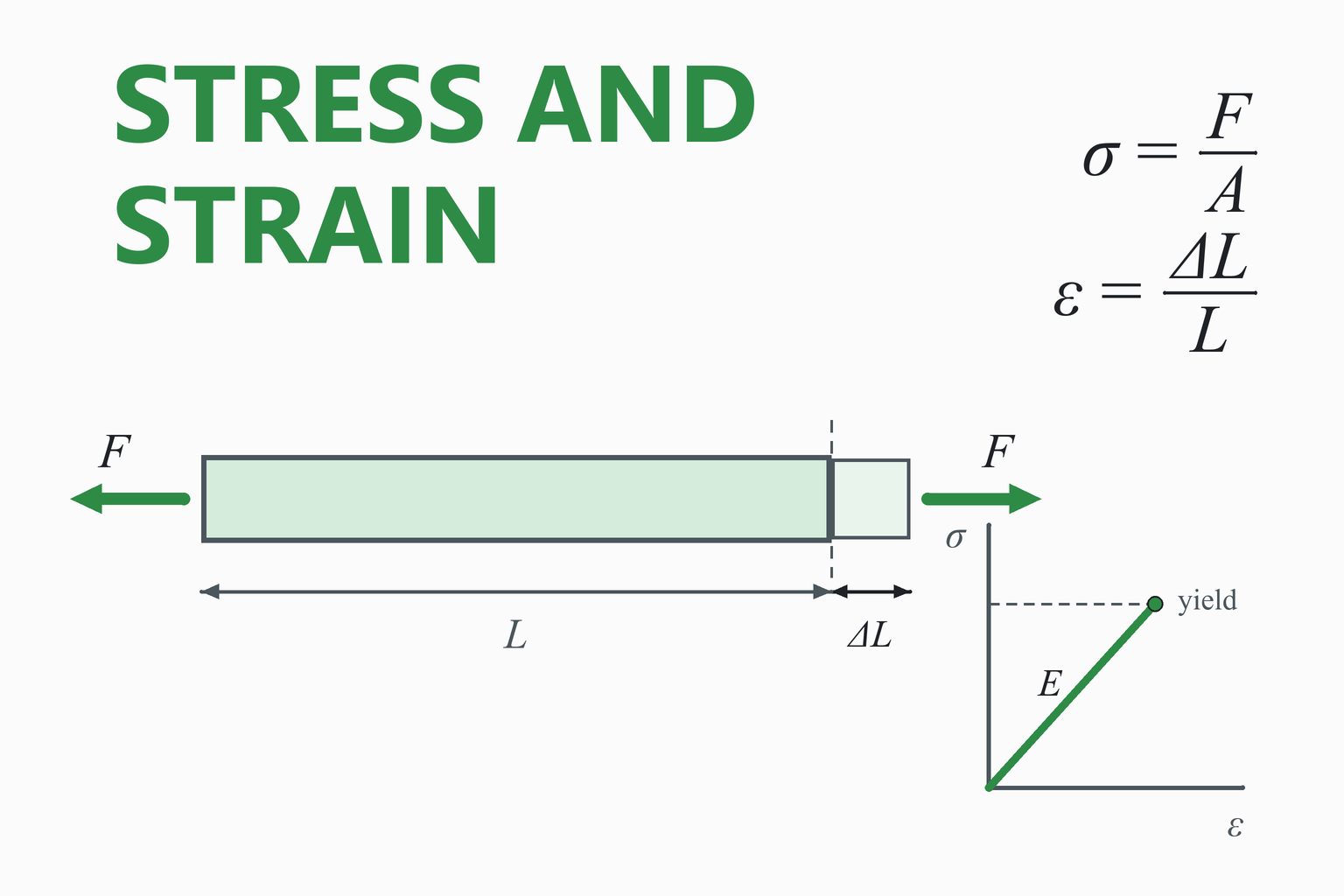
Calculate Stress, Strain and Elongation of a Bar Under Load
Normal stress, strain, elongation and lateral contraction; modulus and true stress from a tensile test; shear stress and strain
Stress is the force a material carries per unit of area, and strain is how much it stretches per unit of length. Together they tell you whether a rod, bolt, pin or bracket is strong enough, and how much it will deform under load. This calculator takes the load and the shape of the section and gives the stress, strain and elongation, how much the bar gets thinner (Poisson’s ratio), the strain energy and the factor of safety against yield. It can also work from a tensile-test measurement (force and elongation) to the modulus and the true stress and strain, and it handles direct shear in pins and bolts.
Stress and Strain Calculator
Linear elastic material · uniform stress over the section · room temperature
Where you are on the stress–strain line
—
Educational and preliminary-design tool. The equations assume a straight, uniformly loaded bar of one linear-elastic material, with the load through the centroid. They do not include stress concentrations at holes and shoulders, bending, buckling of slender members, residual stress, temperature or fatigue.
Use real material data for the grade you buy, and have safety-critical parts checked by a qualified engineer.
How to Use the Calculator
- Pick a mode. “Axial load” for a bar in tension (or compression), “Tensile test” if you measured force and elongation, “Direct shear” for a pin or bolt cut across.
- Choose the material or enter E, Poisson’s ratio and the strengths. The presets are typical values.
- Describe the section. A solid round bar, a rectangle, a tube or a known area. The area is the one that carries the load: for a threaded rod use the tensile stress area, not the shank.
- Enter the load and the length. The result shows the stress, the strain and the elongation, and compares the stress with the yield strength.
- Check the chart. If the dot is above the yield line, the elastic equations stop being valid and the part deforms permanently.
Tip: compare the stress with the yield strength for ductile parts and with the ultimate strength for brittle ones. The factor of safety lines show both.
Worked Examples
1. A steel rod in tension
Problem. A 20 mm diameter rod of structural steel (A36: E = 200 GPa, ν = 0.30, Sy = 250 MPa) is 2 m long and carries a tensile load of 60 kN. Find the stress, strain, elongation, change of diameter and the factor of safety.
- Area.A = π × 20² / 4 = 314.16 mm²
- Stress.σ = F / A = 60,000 / 314.16 = 190.99 MPa
- Strain and elongation.
ε = σ / E = 190.99 / 200,000 = 9.549 × 10⁻⁴ (955 µε)ΔL = ε L = 9.549 × 10−4 × 2,000 = 1.910 mm
- Lateral contraction.
εlat = −ν ε = −2.865 × 10⁻⁴, so the diameter shrinks by 20 × 2.865 × 10−4 = 5.73 µm
- Strain energy and factor of safety.
U = F ΔL / 2 = 60,000 × 0.001910 / 2 = 57.3 Jnyield = 250 / 190.99 = 1.31
Result: 191 MPa, a strain of 0.095%, an elongation of 1.91 mm, and a factor of safety of 1.31 against yield (2.09 against the ultimate strength of 400 MPa). The rod stays elastic and returns to its length when the load is removed.
2. Finding the modulus from a tensile test
A 12.5 mm diameter aluminium 6061-T6 bar with a 50 mm gauge length extends 0.072 mm under 12 kN. The area is 122.7 mm², so σ = 12,000 / 122.7 = 97.78 MPa and ε = 0.072 / 50 = 0.00144 (0.144%). The implied modulus is 97.78 / 0.00144 = 67.9 GPa, which is 98.5% of the 68.9 GPa in the table. The true stress is 97.78 × 1.00144 = 97.93 MPa and the true strain is ln(1.00144) = 0.1439%, almost the same as the engineering values because the strain is so small.
3. A pin in double shear
A 12 mm steel pin carries 20 kN in double shear. Each of the two shear planes has an area of π × 12² / 4 = 113.1 mm², so τ = 20,000 / (2 × 113.1) = 88.4 MPa. With G = E / (2 (1 + ν)) = 76.9 GPa the shear strain is 88.4 / 76,923 = 1,149 µrad. The shear yield strength is taken as 0.577 Sy = 144.3 MPa, so the factor of safety is 1.63.
Stress and Strain Explained
Stress
Cut an imaginary section through a loaded member and the material on one side must pass the force on to the other side. Stress is the intensity of that force: force divided by the area it acts on. A force perpendicular to the section gives a normal stress, and a force along the section gives a shear stress.
Normal and shear stress
In SI units, newtons divided by square metres give pascals; in practice stress is quoted in megapascals (N/mm²) or, in US units, in ksi (1 ksi = 6.895 MPa). For a bar of uniform section pulled through its centroid the normal stress is the same across the whole section.
Strain and Hooke’s law
Strain measures the deformation relative to the original size: ε = ΔL / L, dimensionless (often quoted as a percentage or in microstrain, µε). In the elastic range, stress and strain are proportional, and the constant of proportionality is the modulus of elasticity E, also called Young’s modulus.
Hooke’s law and elongation
The combination A E / L is the axial stiffness of the bar, the force needed for unit elongation. A longer or thinner bar is softer; a stiffer material (larger E) stretches less. Steels have E of about 200 GPa and aluminium alloys about 70 GPa, so under the same stress an aluminium part stretches about three times as much.
Poisson’s ratio
A bar that gets longer also gets thinner. The ratio of the lateral to the axial strain is Poisson’s ratio ν, about 0.3 for most metals: εlat = −ν ε. It also links the three elastic constants of an isotropic material: the shear modulus is G = E / (2 (1 + ν)).
Engineering and true stress and strain
Engineering stress and strain use the original area and length, which is what you measure and what design equations use. True stress and strain use the current values: σtrue = σ (1 + ε) and εtrue = ln(1 + ε). These conversions assume that the volume is constant and the strain is uniform along the gauge length, so they hold up to necking, and not beyond it. For the small strains of elastic design the two are practically the same.
Strain energy
The work done in stretching the bar is stored as elastic energy, U = F ΔL / 2 for a linear spring, or σ² / (2E) per unit volume. It is released when the load is removed, and it is the energy a part can absorb without yielding if it is loaded slowly.
Yield and the factor of safety
The elastic relations hold only up to the yield strength Sy. Ductile parts are normally designed so that the stress stays below it, and the factor of safety against yield is n = Sy / σ. Brittle materials do not yield and are compared with their ultimate strength. For direct shear, a common estimate of the shear yield strength is 0.577 Sy, from the distortion-energy criterion.
Typical Material Properties
| Material | E, GPa | ν | Sy, MPa | Su, MPa |
|---|---|---|---|---|
| Structural steel (ASTM A36) | 200 | 0.30 | 250 | 400 |
| AISI 1045 steel, cold-drawn | 207 | 0.29 | 530 | 630 |
| Stainless steel 304, annealed (ASTM minimum) | 193 | 0.29 | 205 | 515 |
| Aluminium 6061-T6 (minimum) | 68.9 | 0.33 | 240 | 290 |
| Titanium Ti-6Al-4V, annealed | 114 | 0.34 | 880 | 950 |
Common Mistakes
Using the wrong area
A threaded rod carries load through its tensile stress area, smaller than the shank. A bar with a hole or notch is weakest at the reduced section.
Mixing units
1 N/mm² is 1 MPa, and 1 ksi is 6.895 MPa. Lengths in mm and E in GPa give strains correctly only if the units are consistent; use the unit drop-downs.
Using E beyond yield
The line ε = σ / E stops at the yield strength. Beyond it the strain is much larger than the equation gives.
Ignoring stress concentrations
Holes, grooves and shoulders raise the local stress well above the average. Use the stress concentration factor for fatigue and for brittle materials.
Forgetting buckling
A slender bar in compression can buckle at a stress far below yield. The stress equation does not warn you.
Treating a typical value as a guarantee
Handbook values are typical. For design use the minimum properties of the grade, from the supplier or the standard.
Assumptions and Limitations
- Uniform axial stress. The load acts through the centroid on a straight bar, away from the ends, where the stress spreads out.
- Linear elastic, isotropic material. Plastics, rubber, wood, composites and cast materials behave differently. Anisotropic materials need more constants.
- Small strains. The relations assume deformation is small compared with the dimensions.
- No temperature, fatigue or creep effects. Thermal expansion has its own calculator; fatigue is covered by the fatigue calculator.
- Direct shear is an average. The shear stress in a pin is not uniform in practice, and bearing and tear-out checks are not included.
- Shear yield is an estimate. The 0.577 Sy value comes from the distortion-energy criterion.
How This Calculator Was Verified
The results were compared with an independent Python implementation that works in the units engineers use in the workshop (force in kN, lengths in mm, areas in mm², stress in MPa, E in GPa), over 3,000 random sections and loads in all three modes; the two agree to rounding error (the true strain, which involves a logarithm, to 4 × 10⁻¹⁰). The shear-modulus relation was checked both ways, from E and ν to G and back. The page also checks itself live:
| Check | Expected | Calculator |
|---|---|---|
| Steel rod, d 20 mm, 60 kN, 2 m, E 200 GPa | 190.99 MPa; 954.9 µε; 1.910 mm | … |
| ΔL = F L / (A E) and strain energy | 1.910 mm; U = 57.30 J | … |
| Lateral strain, ν = 0.30 | −286.5 µε; −5.73 µm on the diameter | … |
| Tensile test, 6061-T6 bar, 12 kN, 0.072 mm over 50 mm | 97.78 MPa; 0.144%; 67.9 GPa | … |
| True stress and strain for that test | 97.93 MPa; 0.1439% | … |
| Pin in double shear, 12 mm, 20 kN, E 200 GPa, ν 0.30 | 88.42 MPa; G 76.92 GPa; 1,149 µrad | … |
| Factor of safety and unit constants | n = 1.309 (250 / 190.99); 1 ksi = 6.8948 MPa; 1 lbf = 4.4482 N | … |
The “Calculator” column is computed live, by the same code that runs the calculator, in your browser. The material values are typical figures, not guaranteed properties.
Frequently Asked Questions
How do I calculate stress?
Divide the force by the area that carries it: σ = F / A. A 60 kN load on a 20 mm diameter rod (314 mm²) gives 191 N/mm², which is 191 MPa. Use the area at the weakest section, and for a threaded rod the tensile stress area rather than the shank area. For a force along the section (shear), τ = V / A.
How do I calculate strain and elongation?
Strain is the elongation divided by the original length: ε = ΔL / L. In the elastic range, strain is the stress divided by the modulus of elasticity, ε = σ / E, and the elongation is ΔL = F L / (A E). For the 2 m steel rod above, ε = 191 / 200,000 = 0.00095 and ΔL = 1.91 mm.
What is Young’s modulus?
Young’s modulus E, or the modulus of elasticity, is the ratio of stress to strain in the elastic range. It measures stiffness: about 200 GPa for steels, 193 GPa for stainless steel, around 70 GPa for aluminium alloys and 114 GPa for the common titanium alloy. A material with a higher E stretches less under the same stress.
What is Poisson’s ratio?
It is the ratio of the lateral contraction to the axial extension when a bar is stretched: εlat = −ν ε. Metals have a value around 0.3. It also connects the shear modulus to the modulus of elasticity: G = E / (2 (1 + ν)).
What is the difference between engineering and true stress and strain?
Engineering values use the original area and length. True values use the current ones: σtrue = σ(1 + ε) and εtrue = ln(1 + ε). The conversion assumes constant volume and uniform strain, so it is valid up to necking only. At the small strains of elastic design the difference is negligible.
How do I find the modulus of elasticity from a tensile test?
Take a force and elongation in the straight, elastic part of the test, divide the force by the original area to get stress, divide the elongation by the original gauge length to get strain, and divide the stress by the strain. Use the “Tensile test” mode. Measure the elongation with an extensometer if you can: the movement of the testing machine includes the grips and the machine itself, and gives a modulus that is too low.
How do I calculate shear stress in a pin or bolt?
Divide the shear force by the area of the shear planes: τ = V / (n A), where n is 1 for single shear and 2 for double shear. For a 12 mm pin carrying 20 kN in double shear, τ = 20,000 / (2 × 113.1) = 88 MPa. A common estimate of the shear yield strength is 0.577 times the tensile yield strength.
What are the units of stress?
Force per area: pascals (N/m²), most often megapascals, where 1 MPa = 1 N/mm². In US units, psi (pounds per square inch) and ksi (1,000 psi); 1 ksi = 6.895 MPa. Strain has no units and is quoted as a ratio, a percentage or in microstrain (µε, parts per million).
Does Hooke’s law always apply?
No. Stress is proportional to strain only in the elastic range, up to the yield strength for ductile metals (strictly, up to the proportional limit). Above that the material deforms permanently and the strain is much larger than σ / E. The calculator warns you when the stress passes the yield strength you entered.
What is the factor of safety against yield?
It is the yield strength divided by the stress: n = Sy / σ. A value of 1 means the part is just at yield. How much more you need depends on the loads, the material data, the consequences of failure and the applicable code. The factor of safety calculator on this site covers combined stresses and design factors.
References and Further Reading
- Hibbeler, R. C. Mechanics of Materials. Pearson. (Stress, strain, Hooke’s law, Poisson’s ratio, shear and strain energy.)
- Beer, F. P., Johnston, E. R., DeWolf, J. T., & Mazurek, D. F. Mechanics of Materials. McGraw-Hill.
- Budynas, R. G., & Nisbett, J. K. Shigley’s Mechanical Engineering Design. McGraw-Hill. (Material properties tables and the distortion-energy shear yield estimate.)
- ISO 6892-1, Metallic materials: tensile testing at room temperature. ASTM E8, Standard test methods for tension testing of metallic materials.