
Calculate Hydraulic Cylinder Force, Speed and Flow
Extend and retract force, piston speed, oil flow and pump power for a double-acting cylinder, in metric and US units
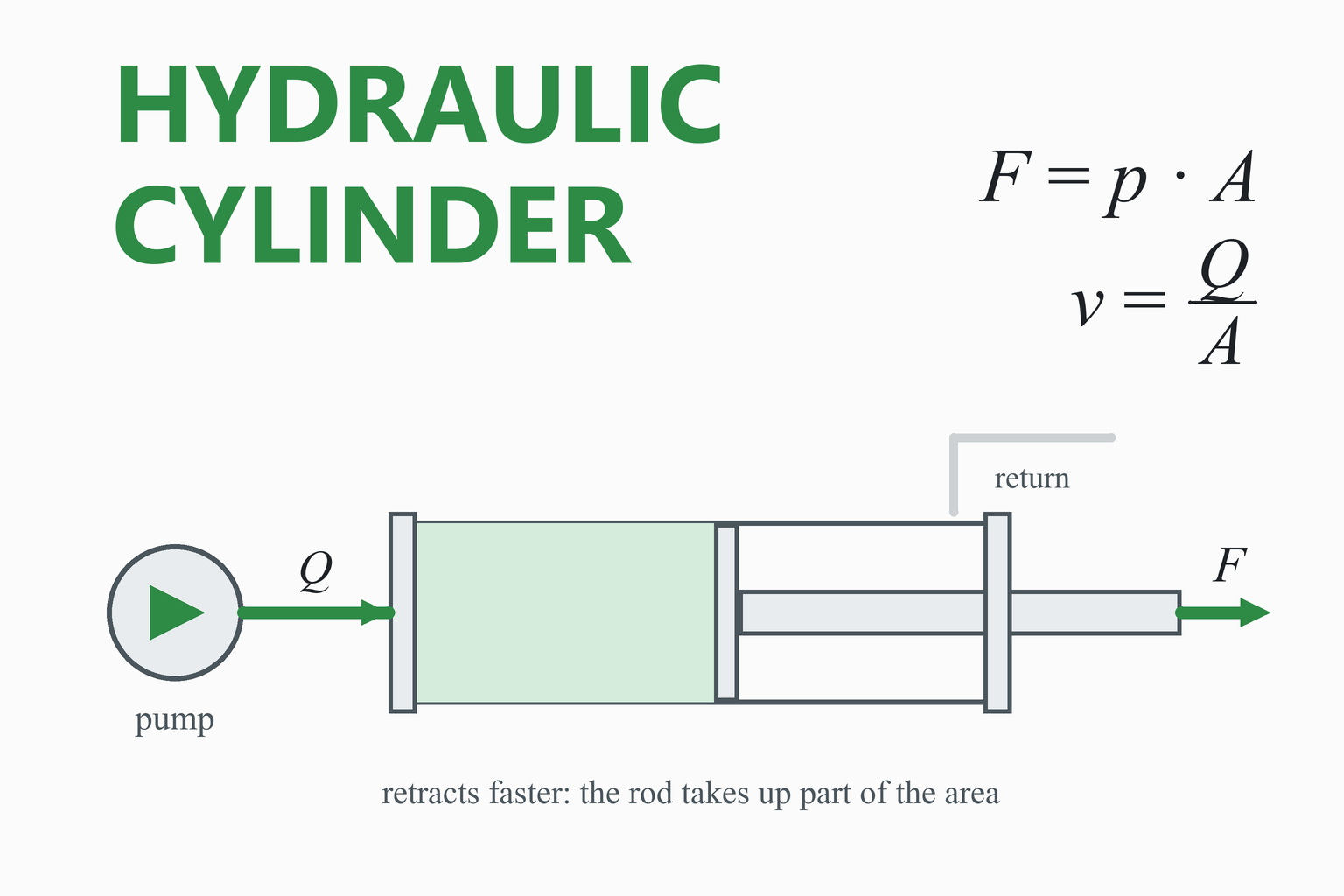
A hydraulic cylinder turns oil pressure into force and oil flow into speed. The force is the pressure times the piston area, the speed is the flow divided by that area, and the two never trade off: a large piston gives more force and less speed for the same pump. The rod makes the cylinder different in the two directions, which is why a double-acting cylinder retracts faster and pushes less than it extends. This calculator gives the force in both directions, the speed and stroke time for the pump flow you enter, the oil volume and the flow leaving the cylinder, the power the pump must supply, and the regenerative extension values. It can also work backwards from a load to the bore you need.
Hydraulic Cylinder Calculator
Double-acting single-rod cylinder · gauge pressure · oil treated as incompressible · losses entered as efficiencies
Usable force against pressure
—
Educational and preliminary-sizing tool. The results are steady-state estimates for an incompressible fluid. They do not include pressure losses in hoses and valves, acceleration, cushioning, leakage past the piston, rod buckling or the effect of temperature on the oil.
Hydraulic systems store enormous energy and a failed hose or fitting can cause serious injury. Size components from the manufacturers’ data, follow the relevant safety standards, and have safety-critical designs checked by a qualified engineer.
How to Use the Calculator
- Pick a mode. “Check a cylinder” gives forces, speeds and power for a cylinder you have. “Find the bore for a load” gives the bore a given force needs.
- Enter the cylinder. Bore and rod diameter set the two areas. Add the stroke to see the oil volume and the stroke times.
- Enter the pressure at the cylinder and the flow from the pump. Pressure at the cylinder is lower than at the pump by whatever the hoses and valves drop.
- Set the efficiencies. The defaults (95% extending, 90% retracting, 87% for the pump) are typical values, not measurements of your system.
- Add the load to see the margin and the pressure it needs. The regenerative values appear in the results table.
Tip: look at the “oil leaving the cap side while retracting” line. With a rod that is half the bore, it is 1.33 times the pump flow, and the return line and valve must be sized for that, not for the pump flow.
Worked Example: An 80 mm Cylinder at 160 bar
Problem. A cylinder has an 80 mm bore, a 45 mm rod and a 400 mm stroke. The pump sends 30 L/min at 160 bar to the cylinder. Find the forces, speeds, stroke times, return flows and the pump power, taking 95% efficiency when extending, 90% when retracting and 87% for the pump.
- Areas.
A = π × 8² / 4 = 50.27 cm² Arod = π × 4.5² / 4 = 15.90 cm² Aannulus = 34.36 cm²
- Force. kN = bar × cm² / 100.
extend: 160 × 50.27 / 100 = 80.42 kN retract: 160 × 34.36 / 100 = 54.98 kNusable: 0.95 × 80.42 = 76.40 kN 0.90 × 54.98 = 49.48 kN
- Speed. v = Q / A, with Q = 30 L/min = 0.5 L/s.
extend: 0.5 × 1000 cm³/s / 50.27 cm² = 9.95 cm/s = 99.5 mm/sretract: 500 / 34.36 = 14.55 cm/s = 145.5 mm/s
- Stroke times.
extend 400 / 99.5 = 4.02 s retract 400 / 145.5 = 2.75 s
- Oil volume and return flow.
extend 50.27 × 40 = 2.01 L retract 34.36 × 40 = 1.37 Loil leaving the rod side while extending: 30 × 34.36 / 50.27 = 20.5 L/minoil leaving the cap side while retracting: 30 × 50.27 / 34.36 = 43.9 L/min
- Power. kW = bar × L/min / 600.
hydraulic: 160 × 30 / 600 = 8.00 kW pump drive: 8.00 / 0.87 = 9.20 kW
- Regenerative extension (rod side connected to the cap side): speed Q / Arod and force p × Arod.
speed 500 / 15.90 = 31.4 cm/s = 314 mm/s usable force 0.95 × 160 × 15.90 / 100 = 24.2 kN
Result: the cylinder pushes with about 76 kN and pulls with about 49 kN, extends at 99.5 mm/s in 4.0 seconds and retracts at 145.5 mm/s in 2.75 seconds. The retract stroke sends 43.9 L/min back through the return line, 46% more than the pump delivers. The pump needs 8 kW of hydraulic power and about 9.2 kW at the shaft. Connected regeneratively it would extend more than three times faster, but with only about a third of the force.
Finding the bore for a load
To push 50 kN at 160 bar with 95% efficiency, the bore must be √(4 × 50,000 / (π × 0.95 × 16,000,000)) = 64.7 mm. At 100 mm/s that cylinder needs 0.1 m/s × 32.9 cm² = 19.7 L/min. Round up to the next bore your supplier makes, then check it with the “Check a cylinder” mode.
How Hydraulic Cylinder Force and Speed Work
Oil is nearly incompressible, so a hydraulic cylinder behaves like a lever with a fixed ratio between force and speed. Pressure acts on the piston and gives force; flow fills the chamber and gives speed. The two equations that run everything are below, and the third is power, which ties them together.
Force, speed and power
With p the gauge pressure, A the effective piston area, Q the flow into the cylinder and P the hydraulic power. In metric shop units: force in kN = pressure in bar × area in cm² / 100, speed in m/s = flow in L/min / (6 × area in cm²), and power in kW = pressure in bar × flow in L/min / 600. In US units: speed in in/s = 231 × gpm / (60 × area in in²), which is 3.85 × gpm / in², and power in horsepower = psi × gpm / 1714.
The rod: two different areas
On extension the oil pushes on the full piston (cap side) and the rod side drains. On retraction the oil enters the rod side, where the area is the annulus (piston minus rod). The ratio of the two areas decides everything that differs between the directions:
- Force: the retract force is the extend force divided by the area ratio.
- Speed: the retract speed is the extend speed times the area ratio, for the same flow.
- Return flow: the oil leaving the cylinder is not equal to the oil entering it. On extension it is the pump flow divided by the area ratio. On retraction it is the pump flow multiplied by the area ratio, which can be a lot: a 2:1 cylinder returns twice the pump flow.
Regenerative circuits
In a regenerative circuit, the oil leaving the rod side on extension is sent back to the cap side to join the pump flow. The cap side then sees the pump flow plus the oil from the rod side, while the pressure acts on both sides, so only the rod area is left to push: the force is p × Arod and the speed is the pump flow divided by the rod area. That is a faster, weaker extension. A published example with a 10 in² piston and a 2 in² rod, 10 gpm and 1,000 psi gives 1,155 in/min and 2,000 lbf, which the calculator reproduces. Regeneration trades force for speed; with a 2:1 area ratio, extension and retraction take about the same time.
Efficiency
Seals and bearings cause friction that is roughly independent of pressure, so it is a smaller share of the extend force than of the retract force. One trade article gives a mechanical-hydraulic efficiency of about 95% when a single-rod cylinder extends, and 85 to 90% when it retracts, with the exact values depending on the seals. Leakage past a cylinder in good condition is small, and this calculator does not include it. For the pump, the overall efficiency (mechanical times volumetric) is typically below 90%: figures of about 0.87 are quoted for axial-piston pumps, and somewhat higher for good gear pumps.
Sizing step by step
- Pick the pressure your power unit and components allow, and subtract an allowance for pressure drop in hoses and valves.
- Find the area from the force: A = F / (η p), using the retract area if the load is carried on retraction.
- Round the bore up to a standard size and choose a rod that will not buckle for the stroke and mounting.
- Find the flow from the speed you want: Q = v · A. Check the retract flow, which is higher.
- Find the power: kW = bar × L/min / 600, divided by the pump efficiency.
Common Mistakes
Using the piston area for the retract stroke
The retract side has the annulus area. Using the full piston area overstates the retract force and understates the retract speed.
Forgetting the return flow
On retraction the oil leaving the cap side is larger than the pump flow. An undersized return line or valve raises the back pressure and slows the cylinder.
Using the pump pressure
Pressure at the cylinder is what counts, and hoses, valves and the back pressure of the other side reduce it.
Skipping the buckling check
A long, slender rod pushing a load can buckle well below the force the cylinder could deliver. Check the manufacturer’s stroke and mounting limits.
No margin at all
A cylinder that just reaches the load has no force left to accelerate it. Add margin, and check the relief valve setting against the pressure you use.
Mixing units
1 bar is 14.5 psi, 1 US gallon is 3.785 litres and 1 horsepower is 0.7457 kW. Use the drop-downs instead of converting by hand.
Assumptions and Limitations
- Double-acting, single-rod cylinders. Double-rod cylinders, telescopic cylinders and plunger cylinders are not covered.
- Steady state. The force and speed are constant values. Acceleration, deceleration and cushioning are not included.
- Incompressible oil and no leakage. The speed is exactly flow over area. Real cylinders also have a small slip and the oil compresses a little.
- No line losses. Hoses, valves and fittings drop pressure; enter the pressure at the cylinder, not at the pump.
- Efficiencies are inputs. They are single numbers for all losses. Use the manufacturer’s data when you have it.
- No structural check. Rod buckling, rod and tube stresses, mounting loads and side loads are not calculated.
How This Calculator Was Verified
The equations were compared with an independent Python implementation written in the units hydraulic engineers use (areas in cm², bar and L/min: kN = bar × cm² / 100, m/s = L/min / (6 × cm²), kW = bar × L/min / 600) over thousands of random cylinders, and separately in US units (in², psi and gpm: in/s = 231 × gpm / (60 × in²), hp = psi × gpm / 1714.3). The two agree to rounding error. Published worked examples were also reproduced: a 160 bar, 80 mm cylinder (80.4 kN), 250 bar at 180 L/min (75 kW at the pump outlet, 83.3 kW at 90% efficiency) and the regenerative example above. The page also checks itself live:
| Check | Expected | Calculator |
|---|---|---|
| 3.5 in bore at 3,000 psi | 9.621 in²; 28,863 lbf | … |
| 80 mm bore at 160 bar | 50.27 cm²; 80.42 kN | … |
| 10 in² piston, 2 in² rod, 10 gpm, 1,000 psi | extend 231 in/min; regenerative 1,155 in/min and 2,000 lbf | … |
| 1,000 psi at 10 gpm | 5.833 hp (the rounded rule psi × gpm / 1714 gives 5.834) | … |
| 250 bar at 180 L/min, pump 90% | 75.0 kW hydraulic; 83.3 kW at the shaft | … |
| Return flow, 100/56 mm cylinder, 20 L/min | area ratio 1.457; 13.7 L/min out when extending, 29.1 L/min when retracting | … |
| Bore for 50 kN at 160 bar, 95%, with 100 mm/s | 64.7 mm; 19.7 L/min | … |
The “Calculator” column is computed live, by the same code that runs the calculator, in your browser. The typical efficiencies are values from trade literature, not measurements of your equipment.
Frequently Asked Questions
How do I calculate the force of a hydraulic cylinder?
Multiply the gauge pressure by the piston area: F = p × A. In metric shop units, force in kN = pressure in bar × area in cm² / 100, so 160 bar on an 80 mm bore (50.27 cm²) gives 80.4 kN. For the retract stroke use the annulus, the piston area minus the rod area. Real cylinders deliver somewhat less because of friction, so the calculator also shows a usable force at the efficiencies you enter.
How do I calculate hydraulic cylinder speed from pump flow?
Divide the flow by the effective area: v = Q / A. In metric shop units, speed in m/s = flow in L/min / (6 × area in cm²). In US units, speed in in/s = 231 × gpm / (60 × area in in²), which is 3.85 × gpm / area. Use the full piston area for extension and the annulus for retraction.
Why does a double-acting cylinder retract faster than it extends?
On retraction the oil works on the rod side, where the area is smaller because the rod takes up part of it. The same flow into a smaller area moves the piston faster, so retract speed is the extend speed times the area ratio. The price is force: the retract force is the extend force divided by the area ratio.
How much oil flows out of the cylinder when it retracts?
More than the pump delivers. The oil leaving the cap side on retraction is the pump flow multiplied by the area ratio (piston area divided by annulus area). With a rod half the bore that is 1.33 times the pump flow, and with a 2:1 area ratio it is twice the pump flow. The return line and valve have to be sized for that flow. On extension the flow leaving the rod side is the pump flow divided by the area ratio.
What is a regenerative circuit?
In a regenerative circuit, the oil leaving the rod side during extension is sent back to the cap side to join the pump flow. Only the rod area is then left to produce force, so the force is pressure times rod area and the speed is the pump flow divided by the rod area. A published example with a 10 in² piston, a 2 in² rod, 10 gpm and 1,000 psi gives 1,155 in/min and 2,000 lbf. It is a faster but weaker extension, used when the full force is not needed on the whole stroke.
How much power does a hydraulic cylinder need?
The hydraulic power is pressure times flow. In metric units kW = bar × L/min / 600, so 160 bar at 30 L/min is 8 kW; in US units hp = psi × gpm / 1714. The pump needs more at its shaft, by its overall efficiency: at 87% the 8 kW example needs 9.2 kW. Figures of about 0.87 are quoted for axial-piston pumps.
What efficiency should I use for a hydraulic cylinder?
A trade article on cylinder efficiency gives about 95% mechanical-hydraulic efficiency when a single-rod cylinder extends and 85 to 90% when it retracts, because seal friction is roughly constant and is a larger share of the smaller retract force. The actual value depends on the seals and the pressure. Leakage in a good cylinder is small and is not included. The defaults here are 95% and 90%.
How do I choose the bore for a load?
Divide the force you need by the pressure at the cylinder and by the efficiency to get the piston area, then take the bore from the area and round up to a standard size. If the load is carried on retraction, use the annulus area, which depends on the rod diameter. The “Find the bore for a load” mode gives the exact bore, and the flow and power for a speed you choose.
Does the calculator check rod buckling or cylinder strength?
No. A long, slender rod that pushes a load can buckle at a force well below what the cylinder can produce, and the tube, rod and mounting must also carry the force. Use the manufacturer’s data for stroke, mounting and buckling limits, and have critical designs checked by a qualified engineer.
What pressure should I use in the calculator?
Use the pressure at the cylinder while it moves the load, not the relief valve setting or the pump outlet pressure. Hoses, valves and the back pressure on the other side of the piston all reduce it. To find what a load needs, enter it as the load and read the gauge pressure needed.
References and Further Reading
- Esposito, A. Fluid Power with Applications. Pearson. (Cylinder force, speed and power relations.)
- Hydraulics & Pneumatics and Power & Motion trade articles on regenerative circuits and on the mechanical efficiency of hydraulic cylinders.
- ISO 3320, Fluid power systems and components: cylinder bores and piston rod diameters and area ratios.
- ISO 6020 and ISO 6022, Hydraulic fluid power: mounting dimensions for single rod cylinders (16 MPa and 25 MPa series).
- Cylinder and pump manufacturers’ catalogues (Parker, Bosch Rexroth, Eaton, Hydac and others): rated pressures, stroke and buckling limits, and pump efficiency data.