
Calculate Bolt Tightening Torque and Preload
Metric and inch bolts, ISO 898-1 and SAE grades, nut-factor or thread-friction method, with the scatter you should expect
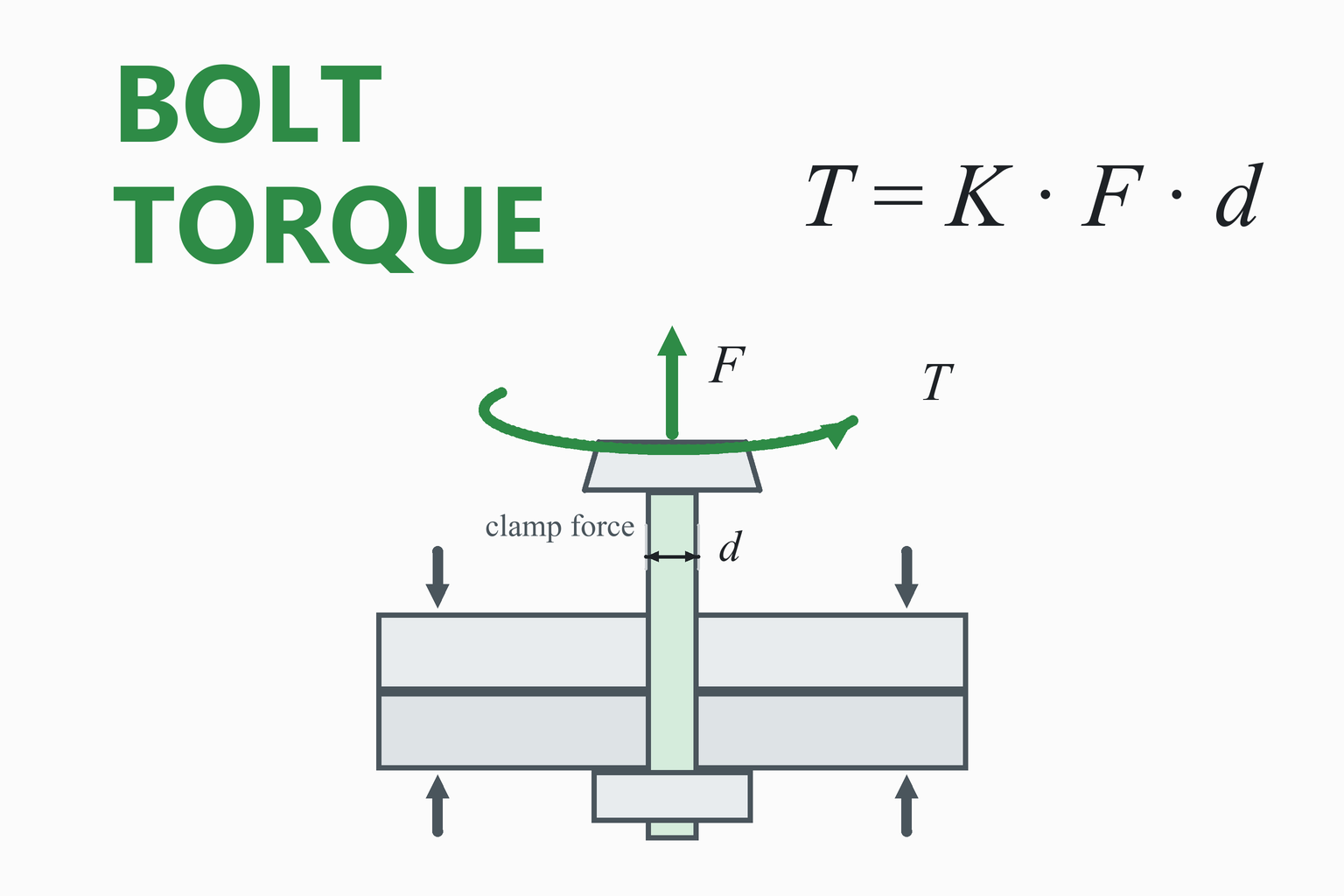
A bolt does its job by being stretched: the tension, called the preload, clamps the joint together. You cannot measure that tension with a spanner, so you tighten to a torque and rely on the relationship T = K × F × d. This calculator works in both directions: it finds the torque for a target preload (such as 75% of the bolt’s proof load), or the preload you get from a torque you applied. It knows the standard thread sizes and bolt grades, offers the quick nut-factor method and a more detailed one that separates thread friction from friction under the head, and shows where the torque goes.
Bolt Torque and Preload Calculator
Static preload · single bolt · torque-controlled tightening · friction is the biggest uncertainty
| Tensile stress area AtFrom the thread dimensions | — |
|---|---|
| Pitch diameter d2 | — |
| Proof strength Sp | — |
| Proof load Fp = Sp · At | — |
| Preload F in the bolt | — |
| Preload compared with the proof load | — |
| Tensile stress in the threads σ = F / At | — |
| Tightening torque T | — |
| Equivalent nut factor K = T / (F · d) | — |
| Likely preload range for the scatter above | — |
| Highest likely preload | — |
Where the tightening torque goes
—
Educational and preliminary-design tool. It gives the preload you can expect from a torque for a single bolt with ideal, uniform friction. It does not include embedding and relaxation, joint stiffness and external-load sharing, fatigue, thread-stripping, torsion locked into the shank, or the limits of the clamped parts.
For critical joints (pressure equipment, structural connections, vehicles, lifting gear), follow the applicable standard (for example VDI 2230) or the manufacturer’s specification, and verify the preload by test.
How to Use the Calculator
- Choose the thread and grade. The calculator looks up the stress area and the proof strength. Metric sizes use the ISO property classes; inch sizes use SAE grades 5 and 8. Use “Custom” for a size that is not listed.
- Decide what you know. Normally you start from the preload the joint needs and want the torque to set on the wrench. If a bolt has already been tightened to a known torque, switch to “find the preload”.
- Pick a preload target. 75% of the proof load is the usual starting point for a joint that will be taken apart again; 90% is used for permanent joints. Or enter a force from your own joint calculation.
- Describe the friction. The quick method needs one number, the nut factor K. The detailed method takes separate friction coefficients for the thread and for the surface under the head or nut, which is more physical and shows where the torque goes.
- Read the results and the scatter. The range shows what preloads are likely if the torque is accurate but friction varies. If the top of the range reaches the proof load, the target is too aggressive for torque control.
Tip: Changing a unit drop-down converts the number in that field, so the physical value stays the same. If you lubricate a bolt that a torque table assumed to be dry, reduce the torque; the same torque would give a much higher preload.
Worked Example: An M10 Class 8.8 Bolt
Problem. A zinc-plated M10 × 1.5 class 8.8 bolt clamps a removable cover. Find the tightening torque for a preload of 75% of the proof load, using the nut-factor method, and compare it with the detailed friction method for an oiled bolt.
- Stress area.
At = (π/4)(d − 0.9382 P)² = (π/4)(10 − 0.9382 × 1.5)² = 57.99 mm²
- Proof load. The proof strength of class 8.8 up to M16 is 580 MPa.
Fp = Sp At = 580 × 57.99 = 33.6 kN
- Target preload for a reusable joint.
F = 0.75 × 33.6 = 25.2 kN
- Torque with the nut factor. Zinc-plated bolts have a typical K of 0.20.
T = K F d = 0.20 × 25,226 N × 0.010 m = 50.5 N·m
- Scatter. With ±25% scatter the actual preload will lie between 18.9 and 31.5 kN, which is 56% to 94% of the proof load. The highest value is still below the proof load, so the bolt should not yield.
- The detailed method for the same bolt, oiled (μ = 0.12 for both thread and head, mean bearing diameter 13 mm). The pitch diameter is d2 = 10 − 0.6495 × 1.5 = 9.026 mm.
T / F = P/(2π) + μt d2 / (2 cos 30°) + μb Db / 2= 0.2387 + 0.6253 + 0.7800 = 1.644 mmT = 25,226 N × 1.644 mm = 41.5 N·m (equivalent K = 0.164)
Result: about 50 N·m for the zinc-plated bolt and 41.5 N·m for the oiled one, to reach the same 25.2 kN preload. Look at the split: only 14.5% of the torque stretches the bolt, 38% goes into thread friction and 47% into friction under the head. If you used 50 N·m on the oiled bolt, the preload would be about 30.7 kN, or 91% of the proof load, from the same wrench setting.
What Is Bolt Preload and Why Does It Matter?
When you tighten a nut, the bolt stretches slightly like a very stiff spring, and the clamped parts are squeezed. That tension in the bolt is the preload. It is the whole point of the joint:
- It holds the parts together by friction and by compressing them, so the joint carries load without sliding or opening.
- It protects the bolt from fatigue. A bolt is much more flexible than the parts it clamps. With enough preload, most of an external tensile load simply reduces the compression in the parts, and the bolt sees only a small fraction of the cycling (the share depends on the relative stiffness of bolt and joint, a ratio often well below one half).
- It keeps the nut from loosening under vibration, because the clamping load stays above what the vibration can overcome.
Too little preload gives a loose, leaking or fatigue-prone joint. Too much stretches the bolt past its elastic limit, strips threads or crushes the clamped material. That is why preload is specified as a fraction of the bolt’s proof load, the load it can carry and still return to its original length.
From Torque to Preload
Preload cannot be read directly, so assemblies are tightened to a torque. The torque turns the nut up the thread, which behaves like a wedge wrapped around the bolt, and stretches the bolt. Friction opposes the motion in two places, in the threads and under the head or nut, and it takes most of the effort.
The short-form relation
T is the tightening torque, F the preload, d the nominal bolt diameter and K the nut factor (or torque coefficient), a single number that lumps all the friction together. It is dimensionless and typically about 0.2.
The detailed form (the VDI 2230 expression for a 60° thread)
P is the thread pitch, d2 the pitch diameter, μt the thread friction coefficient, μb the friction coefficient under the head or nut and Db the mean diameter of that bearing surface. The three terms are the torque that stretches the bolt, the thread friction and the head friction. The coefficients 1/(2π) = 0.159 and 1/(2 cos 30°) = 0.577 appear in the standard rounded to 0.16 and 0.58.
Compare the two: the nut factor is K = T/(F d) = [P/(2π) + μt d2/(2cos30°) + μb Db/2] / d. For common bolts the detailed result works out near 0.15 to 0.25, which is why 0.2 is the usual default.
The Nut Factor K
| Bolt condition | Nut factor K |
|---|---|
| Non-plated, black finish | 0.30 |
| Zinc-plated | 0.20 |
| Lubricated | 0.18 |
| Cadmium-plated | 0.16 |
| Anti-seize compound | 0.12 |
A lower K means less torque is wasted in friction, so the same torque makes a higher preload. This is the most common way to break a bolt: using a torque value published for dry fasteners on bolts that have been oiled or coated with anti-seize.
Bolt Grades, Proof Strength and Stress Area
The tensile stress area At is the effective cross-section of a threaded bolt. For ISO metric threads At = (π/4)(d − 0.9382 P)², and for unified inch threads At = (π/4)(d − 0.9743/n)², with n threads per inch. The proof load is Fp = Sp At.
| Grade | Proof strength Sp | Note |
|---|---|---|
| ISO 4.6 | 225 MPa | Low-carbon steel, general use |
| ISO 5.8 | 380 MPa | |
| ISO 8.8 | 580 MPa up to M16; 600 MPa above | The common “high-tensile” bolt |
| ISO 9.8 | 650 MPa | Defined for M16 and smaller |
| ISO 10.9 | 830 MPa | |
| ISO 12.9 | 970 MPa | Alloy steel; handle with care (see below) |
| SAE grade 5 | 85 ksi up to 1 in; 74 ksi above | 1/4 in to 1-1/2 in |
| SAE grade 8 | 120 ksi | 1/4 in to 1-1/2 in |
How Much Preload?
A widely used rule (for example in Shigley’s Mechanical Engineering Design) is to preload to about 75% of the proof load for reusable connections and 90% for permanent ones. Higher preload gives a stiffer, more fatigue-resistant joint, but leaves less margin for scatter, for the extra load of an applied force and for torsion trapped in the shank. A preload target that looks safe on paper can leave the top of the scatter range above the proof load, which is why the calculator shows that range.
Accuracy of torque tightening
Torque control is cheap and fast but not accurate. The torque wrench itself may be good to a few per cent, but friction changes from bolt to bolt with the finish, the lubricant, how many times the bolt has been used and how fast it is tightened, so the preload scatter is typically tens of per cent. Methods that control the stretch directly (tension-indicating washers, turn-of-nut, direct tension indicators, bolt elongation or ultrasonic measurement) are more accurate and are used for critical joints.
Common Mistakes
Lubricating a “dry” torque
Torque tables usually assume a specific finish. Oil or anti-seize can raise the preload by tens of per cent at the same torque, enough to stretch or break the bolt.
Mixing units
1 lbf·ft = 1.356 N·m. A value in N·mm entered as N·m is wrong by 1000. Use the unit drop-down.
Using the wrong stress area
The thread, not the shank, carries the load. Using the full diameter over-estimates the proof load of an M10 bolt by about a third.
Applying coarse-thread torque to fine threads
Fine threads have a larger stress area and a smaller lead, so they need a different torque for the same percentage of proof load.
Reusing damaged bolts
Stretched, galled or rusted threads have unpredictable friction, and a bolt tightened into yield can have lost its strength.
Trusting the torque for a critical joint
Torque control is only an estimate of preload. For safety-critical work, verify with a method that measures stretch or load.
Assumptions and Limitations
- Single bolt, static preload. Joint stiffness, the share of external load that reaches the bolt, fatigue and joint separation are not calculated.
- Uniform friction. The same coefficient is assumed over the whole thread and under the head. Real friction varies with surface finish, coating, lubricant, tightening speed and reuse.
- Torque only. The tightening torque twists the bolt; much of that torsion relaxes after tightening, and this calculator does not combine it with the tension.
- Nominal proof strength. Real bolts vary; use the certified strength of your batch for critical work. Galvanised, plated or coated bolts may have reduced values or special rules.
- Standard 60° threads (ISO metric and unified). Other thread forms need different formulas.
- No check of the nut, the tapped hole, or the clamped parts: thread stripping, bearing pressure under the head and crushing of soft materials need separate checks.
- Embedding and relaxation (the loss of some preload in the first hours as surfaces settle) are not included.
How This Calculator Was Verified
The stress areas of the coarse metric series (M3 to M36) were compared with the nominal stress areas tabulated with ISO 898-1 and matched to within the 3-figure rounding of the table (0.4%); the unified coarse sizes from 1/4 to 1 inch matched published four-figure values to better than 0.1%. The proof strengths were checked by multiplying them with those areas and comparing with the proof loads published for each ISO property class (32 values, within 0.4%), and the SAE values against SAE J429. The torque equations were compared with an independent Python implementation that also evaluates the exact power-screw equation for a 60° thread, which differs from the simplified VDI form by under 2% (0.5% on average) over 989 random detailed-friction cases. The page’s own code is also checked live against hand calculations:
| Check | Expected | Calculator |
|---|---|---|
| Stress areas, M10, M16, M20, M36 (coarse) | ISO table: 58.0, 157, 245, 817 mm² | … |
| Stress area, 1/2-13 UNC | 0.1419 in² | … |
| M10 class 8.8, 75% of proof, K = 0.20 | Fp = 33.64 kN, F = 25.23 kN, T = 50.45 N·m | … |
| Same bolt, detailed method, μ = 0.12, Db = 13 mm | T/F = 1.644 mm: T = 41.47 N·m, K = 0.164 | … |
| Round trip: that torque back to preload | 25.226 kN | … |
| Share of torque: stretch / thread / head | 14.5% / 38.0% / 47.4% | … |
| Simplified VDI form vs exact power-screw equation | agree within about 2% (usually under 1%) | … |
| 1/2-13 UNC SAE grade 5, 75% of proof, K = 0.20 | Fp = 12,062 lbf; T = 75.4 lbf·ft | … |
The “Calculator” column is computed live, by the same code that runs the calculator, in your browser.
Frequently Asked Questions
How do I calculate the tightening torque for a bolt?
Choose the preload you need, usually 75% of the bolt’s proof load for a reusable joint, and use T = K × F × d, where F is the preload, d the nominal diameter and K the nut factor, typically about 0.2. For an M10 class 8.8 bolt the proof load is about 33.6 kN, so a 75% preload of 25.2 kN needs roughly 50 N·m with K = 0.2.
What is the nut factor (K factor) and what value should I use?
K is a single number that lumps the thread and under-head friction together: T = K·F·d. Shigley lists typical values of 0.30 for non-plated black bolts, 0.20 for zinc-plated, 0.18 for lubricated, 0.16 for cadmium-plated and 0.12 with anti-seize. When the condition is unknown, 0.20 is the usual default. The true value for your fasteners can differ considerably, so test critical joints.
How much preload should a bolt have?
A common guideline is about 75% of the proof load for joints that will be taken apart again and about 90% for permanent joints. Higher preload gives a stiffer, more fatigue-resistant joint but leaves less margin for friction scatter and for any extra stress from the applied load. Always check the specification for your own joint.
Why does lubrication change the torque I should use?
Most of the tightening torque, roughly 80 to 90%, is spent overcoming friction in the threads and under the head. Lubrication lowers the friction, so the same torque stretches the bolt much more. Using a torque table written for dry bolts on lubricated ones can overload or break the bolt. Reduce the torque to match the lower K.
How accurate is torque tightening?
Not very. A good torque wrench controls the torque to a few per cent, but friction varies from bolt to bolt, so the resulting preload commonly scatters by ±25% or more. For critical joints use a method that controls the stretch or the load directly, such as bolt-elongation measurement, tension-indicating washers or turn-of-nut.
What is the tensile stress area of a bolt?
It is the effective cross-section used to find the tensile load capacity of a threaded bolt, a little larger than the root area and smaller than the shank. For ISO metric threads it is At = (π/4)(d − 0.9382 P)², and for unified threads At = (π/4)(d − 0.9743/n)². For an M10 × 1.5 bolt it is about 58 mm².
What do the numbers on a bolt head mean?
On ISO metric bolts, a class such as 8.8 or 10.9 gives the strength: the first number times 100 is roughly the minimum tensile strength in MPa (800 MPa for 8.8) and the second number is the yield-to-tensile ratio in tenths (0.8). SAE inch bolts use radial lines on the head: three lines mark grade 5 and six lines mark grade 8.
Can I reuse a bolt that has been tightened before?
If the bolt was kept below its proof load, it has not been permanently stretched and can often be reused; this is why 75% of proof is the usual target for reusable joints. Do not reuse a bolt that has been tightened past yield, one with damaged or corroded threads, or any fastener the manufacturer designates as single-use, such as torque-to-yield bolts.
Why does this give a different value from the torque table I use?
Torque tables assume a particular grade, finish, lubrication, nut factor and percentage of proof load, which are not always stated. If any of these differ from your case, the torque differs. Enter the same assumptions here to compare, and use the more conservative value when you are not sure.
References and Further Reading
- Budynas, R. G., & Nisbett, J. K. Shigley’s Mechanical Engineering Design. McGraw-Hill. (Chapter 8: threaded fasteners; bolt preload, torque and the nut factor; stress area; proof strength tables.)
- ISO 898-1, Mechanical properties of fasteners made of carbon steel and alloy steel — Part 1: Bolts, screws and studs with specified property classes.
- SAE J429, Mechanical and Material Requirements for Externally Threaded Fasteners.
- VDI 2230, Systematic calculation of highly stressed bolted joints. Verein Deutscher Ingenieure. (Tightening torque relation, friction classes, tightening factor.)
- Bickford, J. H. An Introduction to the Design and Behavior of Bolted Joints. CRC Press.
- Juvinall, R. C., & Marshek, K. M. Fundamentals of Machine Component Design. Wiley. (Threaded fasteners and bolted joints.)
- ASME B1.1, Unified Inch Screw Threads, and ISO 262 / ISO 724 for metric thread series and basic dimensions.